


Think a couple of picks and a prospect will bring Elias Pettersson out of Vancouver? Think again.
He’s 27 and signed through 2031–32 with a full no-movement clause, a true franchise center in his prime.
Any realistic trade starts with two first-round picks, a top-three organizational prospect, a young NHL roster player with term, and real cap flexibility.
We’ll break down those asset types, compare comparable blockbuster moves, and lay out realistic packages that could even get Vancouver to answer the phone.
Projected Cost to Acquire Elias Pettersson

Getting Elias Pettersson out of Vancouver? You’re talking about one of the biggest trade packages in recent NHL memory. The starting point is two first-round picks, a top-five organizational prospect, and at least one young NHL player with term left. If you don’t have that elite prospect or that second first-rounder, you’re adding another roster piece or a near-NHL-ready prospect just to get the conversation started. Franchise centers don’t move during their prime. When they do, the return is massive.
Pettersson’s 27 at the time of any realistic trade window. He’s right in the middle of his best years, with multiple high-level seasons still ahead. He’s not just an elite even-strength scorer. He produces on the power play, plays strong two-way hockey, and fills a role fewer than ten guys in the league can handle. When teams trade for Pettersson, they’re not just adding goals. They’re getting a play-driver who makes linemates better, anchors special teams, and holds up against opposing top lines.
Any return package needs to cover five different asset types:
Premium draft capital: Two first-round picks minimum. At least one needs to be unprotected or lightly protected.
Elite prospect: Someone in the acquiring team’s top three organizational assets. Ideally a center, winger, or top-pairing defenseman with real NHL upside.
Young NHL roster player: A contributor 25 or younger already playing top-six or top-four minutes, with multiple years of control remaining.
Secondary prospect or extra pick: A second-tier prospect or a high second-rounder to balance out the talent gap Vancouver’s absorbing.
Salary cap flexibility: The acquiring team either has the space to take on Pettersson’s full hit or includes expiring contracts and future considerations that give Vancouver cap relief.
Vancouver only moves him if the return replaces his value over time and speeds up their roster timeline. That means assets that can contribute within two seasons while keeping long-term upside intact. Teams serious about this need to part with cornerstones, not complementary pieces.
Contract Status and Its Impact on Trade Feasibility

Pettersson’s locked in through 2031–32 at $11.6 million per year. Eight-year deal, full no-movement clause. Vancouver gets long-term cost certainty and roster stability. Any acquiring team gets a contract that’s complicated to manage. Pettersson controls his destination through that no-move clause, meaning he has to approve any trade before it happens. That shrinks the pool of realistic suitors to teams he sees as contenders or places he actually wants to go.
The $11.6 million cap hit ranks in the top 15 league-wide. The acquiring team either needs serious cap space or has to move out comparable salary in the deal. Not many teams can absorb that number without making other roster moves, and even fewer can do it while also offering the premium assets Vancouver’s demanding. Teams near the cap ceiling would need to include one or more roster players with term, which adds layers around fit, position, and value. If Vancouver retains salary, it expands the market. But doing that reduces the return and ties up cap space the Canucks could use to speed up their own rebuild or retool.
Six full seasons remaining at the time of a realistic trade window. The acquiring team isn’t just committing cap space. They’re committing long-term roster construction around Pettersson. Win-now teams see that term as an asset, locking in a franchise center through multiple competitive windows. Teams in transition or rebuild see the same term as risk, especially if internal development timelines don’t line up with Pettersson’s prime years. That creates natural trade partners and eliminates others before negotiations even start.
On‑Ice Performance and Franchise Value

Pettersson’s posted three straight seasons above 85 points when healthy. Career-high 102-point campaign in 2022–23 placed him in the league’s top ten scorers. His production isn’t inflated by power-play points or secondary assists. He drives play at even strength, consistently posting shot-share and expected-goals metrics above 52 percent. That puts him in the upper tier of NHL centers for controlling territory and generating dangerous chances. Teams that acquire Pettersson aren’t just adding offense. They’re getting a player who tilts matchups, creates advantages in transition, and delivers strong results across all game states.
His two-way game separates him from pure offensive specialists. Pettersson logs regular penalty-kill minutes, faces top opposing lines in defensive-zone starts, and posts positive defensive metrics relative to his teammates. He’s not a shutdown center, but he doesn’t need sheltering. Coaches can deploy him in any situation without sacrificing defensive structure. That versatility makes him more valuable than wingers or centers who need specific deployment to maximize effectiveness.
Playing center amplifies his trade cost. Franchise-level centers are the rarest commodity in the NHL. Teams routinely overpay to acquire them because of positional scarcity and the on-ice leverage a number-one center provides. Pettersson’s combination of scoring, playmaking, defensive competence, and positional value puts him in a category occupied by fewer than a dozen active players.
Performance markers that justify his valuation: consistent point-per-game production across multiple seasons, including playoff performance that mirrors regular-season output. Even-strength dominance measured by controlled-zone-entry rates, high-danger scoring-chance creation, and shot quality. Strong possession metrics (Corsi For %, expected goals share) that reflect sustained play-driving ability. Penalty-kill contribution and defensive-zone responsibility that distinguish him from one-dimensional offensive players.
Comparable Superstar Trades

| Player | Return Package | Year |
|---|---|---|
| Jack Eichel | Peyton Krebs, Alex Tuch, top-10 protected 2022 1st, 2023 2nd | 2021 |
| Matthew Tkachuk | Jonathan Huberdeau, MacKenzie Weegar, Cole Schwindt, conditional 2025 1st | 2022 |
| Pierre-Luc Dubois | Alex Iafallo, Rasmus Kupari, Gabriel Vilardi, 2024 2nd | 2023 |
| Seth Jones | Adam Boqvist, 2021 1st (12th overall), 2022 1st, 2021 2nd | 2021 |
Each trade involved a combination of NHL roster players with remaining term, high draft capital, and prospects with upside. The Eichel trade centered around a top-10 protected first-round pick and two young NHL contributors. One of them (Tuch) was a proven top-six winger. The Tkachuk deal brought back two established NHL players in their prime, a prospect, and conditional draft capital. Moving a star winger in his mid-20s is rare, and the return reflected that. The Dubois trade, while smaller in total return, still required three roster players and a pick. Even centers with question marks command significant packages.
Pettersson’s trade cost would exceed all these benchmarks. Unlike Eichel, who carried injury uncertainty and a fractured relationship with Buffalo’s front office, Pettersson has no off-ice concerns or medical red flags. Unlike Dubois, who had platform-year performance questions and limited contract certainty, Pettersson’s locked in long-term with proven high-end production. The closest comp is Tkachuk, who returned two quality NHL players, a prospect, and a future first. But even that package might fall short given Pettersson’s positional advantage as a center and his superior two-way metrics. Any realistic Pettersson trade starts with at least two first-round picks, a top-tier prospect, and an NHL roster player. Additional sweeteners to close the gap.
Vancouver’s Motivations: Keeping vs. Trading Pettersson
Vancouver built its roster around Pettersson as a cornerstone. Moving him signals a fundamental shift in franchise direction. He’s the type of player teams spend years trying to acquire through the draft or free agency. Losing that caliber of center without a clear internal replacement creates immediate roster instability.
The Canucks’ front office faces pressure from ownership, fans, and media to stay competitive while managing an aging core and limited cap flexibility. Trading Pettersson provides an influx of assets that could accelerate a rebuild. But it also removes the team’s best play-driver and leaves a massive hole down the middle. If Vancouver believes it can retool around Pettersson rather than tear down, keeping him makes more sense than any return package, no matter how strong. The decision depends on whether management views the current core as capable of contending within Pettersson’s prime window or whether they need to reset entirely.
Internal dynamics matter too. If Pettersson privately expresses frustration with the organization’s direction or lack of success, that changes the equation. A disengaged star, even one under contract, creates risk for both on-ice performance and future roster decisions.
Market pressures and fan expectations add another layer. Vancouver’s a high-revenue market with passionate fans who expect competitive hockey. Trading the team’s best player during his prime would bring immediate backlash unless the return is undeniable and the organization communicates a clear, credible plan. Management has to weigh short-term public relations challenges against long-term roster health. That balance makes the decision to move Pettersson far more complex than simple asset maximization.
Salary Cap and Roster Construction Ramifications
Taking on Pettersson’s $11.6 million cap hit forces the receiving team to make immediate and long-term roster sacrifices. Teams near the upper limit have to either move out comparable salary or gut depth to create space. Both carry risk. Moving out a roster player with term to match salary might solve the cap math, but it also reduces the net talent gain and forces the acquiring team to replace that departed player through internal promotion or additional moves. Teams with significant cap space still face future constraints. Pettersson’s hit stays on the books for six more seasons, limiting flexibility to re-sign pending free agents or add complementary pieces.
The ripple effects go beyond the immediate season. A team that trades for Pettersson commits a big percentage of its cap to one player. That means building around him with cost-controlled entry-level contracts, bridge deals, and strategic veteran additions on short-term deals. That model works if the surrounding roster is young and improving. It creates problems if the team already carries expensive veterans or faces a wave of pending extensions. The salary structure also impacts trade deadline flexibility in future seasons. Teams with tight caps struggle to add rental players or make in-season upgrades without further moves.
Vancouver’s willingness to retain salary would change the dynamics entirely, but doing so comes at a cost. Retaining even 15 to 20 percent of Pettersson’s cap hit over six years ties up between $1.7 million and $2.3 million annually. Money the Canucks could use to sign depth players or absorb bad contracts in exchange for draft picks. Retention makes the trade easier to execute but reduces Vancouver’s return and limits their own cap flexibility during a potential rebuild or retool. The Canucks are more likely to demand full salary absorption unless the return package is so strong that retention becomes necessary to close the deal.
Realistic Trade Scenarios and Team Fits
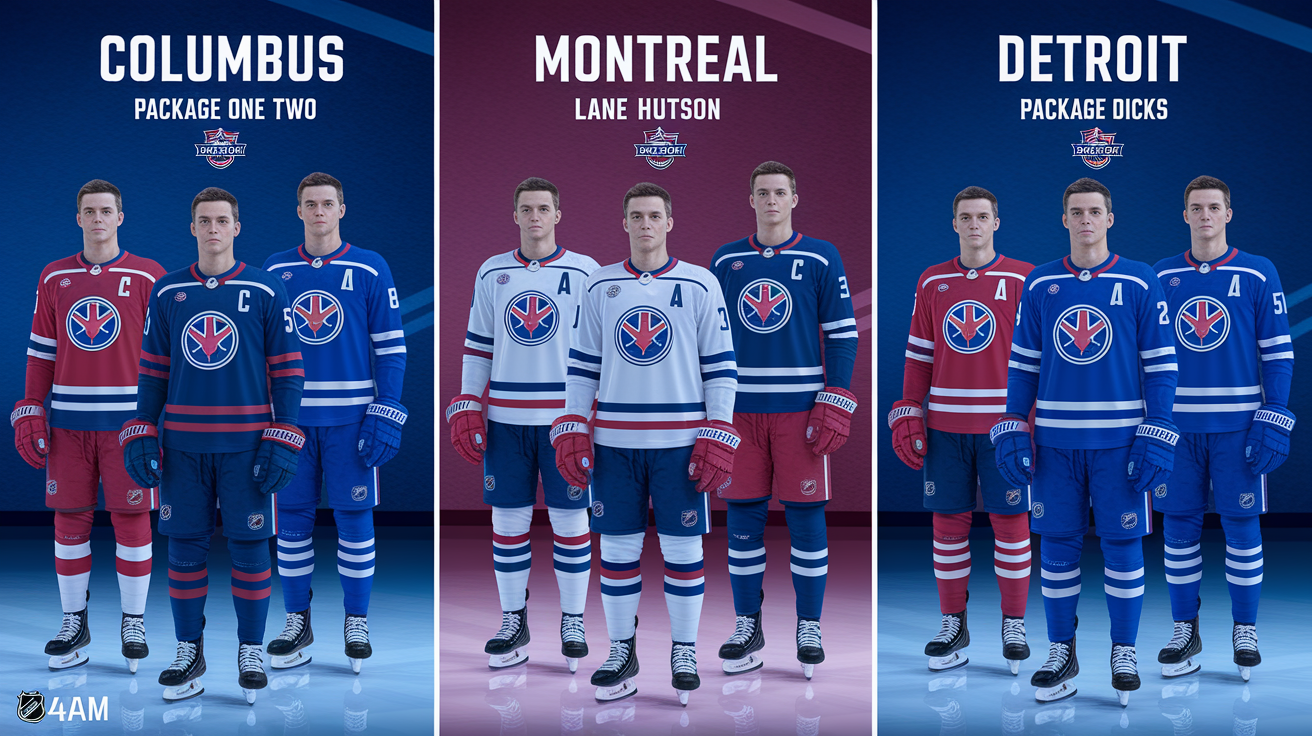
Columbus Blue Jackets
Package One: 2027 unprotected 1st, 2028 1st (top-10 protected), Adam Fantilli, David Jiricek. Columbus has the cap space, the draft capital, and the positional need for a franchise center. Fantilli and Jiricek represent the type of high-upside young assets Vancouver would target.
Package Two: 2027 1st, 2029 1st, Kent Johnson, Denton Mateychuk, Kirill Marchenko. Adds a third prospect and an NHL winger to offset losing Fantilli. Gives Vancouver multiple pathways to replace Pettersson’s offense.
Package Three: 2027 1st, Adam Fantilli, David Jiricek, 2028 2nd, Dmitri Voronkov. Reduces total draft capital but adds a young NHL forward with upside and keeps two premium prospects in the deal.
Montreal Canadiens
Package One: 2027 1st, 2028 1st, Lane Hutson, Joshua Roy. Montreal has the cap space and the prospect depth to make this work. Hutson’s a high-end offensive defenseman who could replace some of Pettersson’s offensive production from the back end.
Package Two: 2027 1st, 2029 1st, Juraj Slafkovsky, David Reinbacher. Moves the best young NHL forward and the top defensive prospect. Gives Vancouver immediate NHL talent and long-term upside.
Package Three: 2027 1st, Lane Hutson, Joshua Roy, Kaiden Guhle, 2028 2nd. Includes two NHL-ready defenders and a scoring forward. Shifts the return toward immediate roster help rather than pure futures.
Detroit Red Wings
Package One: 2027 1st, 2028 1st, Nate Danielson, Simon Edvinsson. Detroit needs a number-one center to accelerate their timeline. Danielson’s a center prospect with two-way upside, and Edvinsson projects as a top-pairing defender.
Package Two: 2027 1st, Nate Danielson, Simon Edvinsson, Marco Kasper, Jonatan Berggren. Adds a second forward prospect and an NHL winger to increase total value without giving up a second first-rounder.
Package Three: 2027 1st, 2029 1st, Simon Edvinsson, Michael Brandsegg-Nygard. Keeps the two firsts but swaps Danielson for a high-upside winger prospect and maintains a top defensive piece.
Final Words
Pettersson is the kind of center that changes a team’s ceiling, an elite scorer with a strong two-way game and a cap profile that forces serious offers.
We laid out why Vancouver would want multiple first-round picks, top prospects, and roster players, and how contract length and cap hit shape the timing.
If you’re asking what would it take to acquire Elias Pettersson, expect a true blockbuster package plus cap creativity — and a team ready to chase a title.
FAQ
Q: Are Quinn Hughes and Elias Pettersson still friends?
A: Quinn Hughes and Elias Pettersson are reportedly still friends, with no public rift; they remain teammates who often appear supportive in media and social posts, though private dynamics aren’t fully known.
Q: What NHL teams are interested in trading for Vancouver Canucks Elias Pettersson?
A: Teams reportedly interested in trading for Elias Pettersson include Columbus, Montreal, Detroit and Chicago; generally those with cap space, top prospects and multiple first‑round picks would be most realistic suitors.
Q: Is Elias Pettersson elite?
A: Elias Pettersson is considered an elite franchise center thanks to top scoring, strong possession metrics, PK utility, and prime‑age upside, making him one of the NHL’s most valuable centers.
Q: What is the trade value of Elias Pettersson?
A: Elias Pettersson’s trade value likely demands multiple first‑round picks, a top prospect, and at least one young NHL roster player; age, production and two‑way impact push the price into blockbuster territory.