


Think the Bruins will move David Pastrnak this summer? Not likely.
His $11.25 million AAV (annual cap hit) through 2030–31, plus contract protections like no-trade or no-movement clauses and a rising salary cap, shrinks the pool of realistic suitors to almost none.
That combo turns Pastrnak into a high-cost, high-return piece teams would have to overpay for, and Boston into a seller demanding game-changing assets back.
This post lays out the contract clauses, cap math, and the few scenarios where a real trade could happen.
Assessing the Real-World Feasibility of a David Pastrnak Trade
David Pastrnak’s $11.25 million annual cap hit runs through the 2030–31 season. That number locks in what he means to the franchise while cutting down the list of teams that could actually pull off a trade. His eight-year deal, signed back in March 2023 for $90 million total, keeps him in Boston through his early thirties and gives the Bruins predictable cap structure. When you’ve got a player producing at Pastrnak’s level (he finished fourth in league scoring last season) and eating up that much salary space, the number of teams that can both afford him and meet Boston’s asking price gets real small, real fast. Whoever takes him on needs the cap room to absorb the hit. And they need the organizational depth to give up multiple premium assets in return.
Boston went 33–39–10 in 2024–25, finishing second to last in the Eastern Conference. First time they’ve missed the playoffs since 2015–16. That kind of collapse naturally gets people asking whether they should pivot toward youth or go all in on the veterans they’ve got left. Trading Pastrnak would mean full teardown mode. But his contract actually looks like a team-friendly asset now that the salary cap’s climbing to a projected $95.5 million. The front office hasn’t shown any public interest in moving him. Internally, the math leans hard toward keeping a guy who just put up 105 points and anchors the entire offense. Missing the playoffs once doesn’t always mean you blow up the foundation, especially when the piece in question is locked in below market value compared to what other superstars are getting now.
Any deal for Pastrnak needs to be overwhelming. Boston would be trading elite production, contract certainty, and their entire offensive identity all at once. The mock scenarios floating around (Carolina offering Logan Stankoven, Andrei Svechnikov, Alexander Nikishin, and multiple picks, or Ottawa’s sprawling proposal with Shane Pinto, Drake Batherson, prospects, and three draft picks) show you the floor. Not the ceiling. Unless the Bruins commit to a multi-year rebuild and get back a haul that fixes goaltending, defense, and future scoring all in one move, this doesn’t feel feasible.
Top logistical barriers:
- Cap space. Few contenders can take on $11.25M without major moves going the other way.
- Return value. Boston’s asking for multiple impact players, top prospects, and first rounders.
- Contract protection. No-trade or no-movement clauses (if they exist) would limit where he can go.
- Franchise optics. Trading a homegrown star signals surrender and risks losing the locker room and the fanbase.
Contract Structure and Salary Cap Hurdles in a Potential Pastrnak Move

Pastrnak’s $11.25 million AAV through 2030–31 gives Boston long-term stability. It also creates a complicated set of problems for anyone trying to trade for him. That eight-year term means whoever takes him on is committing to that cap hit for the next six seasons. That’s either a strength if you’re built to win now, or a burden if your roster needs time to develop. Teams eyeing Pastrnak have to plan around that fixed cost through multiple contract cycles, free agency windows, and internal extension talks. Long-term deals like his cut into annual flexibility, but they also eliminate the risk of losing the player to free agency or having to renegotiate at a higher rate halfway through your competitive window.
The rising salary cap (projected at $95.5 million and expected to keep climbing) makes Pastrnak’s AAV look more manageable while also increasing his trade value. When he signed in 2023, $11.25 million was a big chunk of the cap. As the ceiling grows, that same number becomes easier to absorb. Especially compared to new mega-deals like Kirill Kaprizov’s eight-year, $130 million extension at $17 million per year. Or Connor McDavid’s two-year bridge at $12.5 million annually. Teams that can fit Pastrnak’s number now are basically getting an elite winger at a discount compared to what similar players will cost in the next contract cycle. That gap between market rate and locked-in cost raises his value. But it also raises Boston’s asking price, because the front office knows they’re holding a cap-efficient asset in an inflating market.
| Player | AAV | Term | Cap Context |
|---|---|---|---|
| David Pastrnak | $11.25M | 8 years (through 2030–31) | Signed pre-cap surge; bargain relative to new deals |
| Kirill Kaprizov | $17M | 8 years | Post-cap rise mega-deal; sets new high-water mark |
| Connor McDavid | $12.5M | 2 years | Short bridge; signals player leverage and market shift |
Evaluating Trade Packages for David Pastrnak

Superstar trades almost never deliver equal value. Production, age, contract, positional scarcity…none of it converts cleanly into picks and prospects. When a team moves a player who’s posted three straight 105-point seasons, they’re not just losing goals. They’re losing power-play time, leadership, offensive identity. The team acquiring him overpays because they’re betting on immediate contention and accepting that draft picks and young players come with uncertainty. Pastrnak’s 28 years old. His deal runs through 2030–31. That means any trade partner is buying prime years with runway left, which inflates the cost. Teams looking to win now will pay more than his stats alone suggest, because the alternative is hoping prospects develop into what Pastrnak already is.
The Carolina mock trade (Pastrnak and a 2025 fourth rounder for Logan Stankoven, Andrei Svechnikov, Alexander Nikishin, and a 2026 first) gives you a sense of the scale required. Stankoven’s 22 and has upside, but he’s not at Pastrnak’s proven level. Svechnikov’s 25 and a legitimate top-line winger, but he’s never hit 80 points. Nikishin’s 6′4″, 216 pounds, with 157 points in 193 KHL games. High-end defensive prospect, but unproven in the NHL. Carolina would be trading depth and potential for a known commodity. Boston would be betting that three younger pieces plus future draft capital can replace one franchise player. The Chicago proposal (Korchinski, multiple first rounders including Toronto’s 2025 and Florida’s 2026 or 2027, plus a 2025 second) leans heavy on futures. Makes sense for a rebuilding Blackhawks team with cap space, but it offers Boston less immediate help.
Ottawa’s sprawling package (Shane Pinto, Drake Batherson, Nikolas Matinpalo, Stephen Halliday, two first rounders, and a second) shows why divisional trades cost more. Pinto posted career highs of 37 points and 21 goals last season but he’s still a restricted free agent. Batherson’s logged three straight 60-point campaigns and costs under $5 million, making him a value piece. Matinpalo’s under $900,000 for two years, adds depth. Halliday led Belleville with 51 points. Boston gets quantity and cap flexibility, but none of those pieces individually match Pastrnak’s impact. The Senators would also be handing a division rival the blueprint to reload while gutting their own prospect pool and draft position. That internal cost makes Ottawa less likely to pull the trigger unless they’re certain they can contend right away. Their own rebuild timeline doesn’t really support that.
Minimum components of any real Pastrnak deal:
- At least one established NHL top-six forward or top-four defenseman capable of 50+ points
- A blue-chip prospect ranked in an organization’s top three
- Minimum two first-round picks, one unprotected
- Additional mid-round picks or roster depth to balance cap and positional needs
- Willingness to accept long-term cap commitment without retention
Cap Space Landscape and Which Teams Could Actually Absorb Pastrnak’s AAV

Cap space works differently at the trade deadline than it does in the offseason. That timing gap narrows the list of realistic Pastrnak suitors. At the deadline, teams accrue cap space daily based on unused room. That lets contenders add salary in smaller chunks without needing full-season flexibility. A team with $5 million in space at the deadline can technically acquire a player making $11.25 million if the prorated cost for the remaining weeks fits under their accrued total. But Pastrnak’s long-term deal makes a deadline move basically impossible. Acquiring teams would inherit his full AAV for multiple seasons, not just a rental window. Offseason trades let teams plan around the $95.5 million cap ceiling and make corresponding moves to clear room. But Boston’s unlikely to retain salary on a contract running through 2030–31 because doing so would lock dead cap space for years.
LTIR offers another path for cap-heavy teams, but it’s a workaround, not a real solution. Long-term injured reserve lets teams exceed the cap by the amount of a player’s salary while they’re medically unable to play. That’s why clubs with LTIR situations can sometimes fit large contracts. But LTIR requires an actual injury. And it doesn’t give you offseason flexibility. Those teams still need to be cap compliant before the season starts. A three-team structure could theoretically help if a third party retains a chunk of Pastrnak’s salary and gets draft compensation for it. But Boston would resist that setup because it complicates the return and reduces the net assets they receive. Retained salary arrangements work best for expiring contracts or short-term additions. Not eight-year commitments.
| Team Archetype | Cap Fit Difficulty | Likelihood of Pursuit |
|---|---|---|
| Contender with tight cap | High (requires major salary-out move) | Low unless desperate for scoring |
| Rebuilder with cap space | Low (can absorb AAV easily) | Moderate if timeline accelerates |
| Cap-flexible playoff team | Medium (manageable with offseason planning) | High if competitive window aligns |
| LTIR-heavy team | Medium (depends on injury status and offseason compliance) | Low due to complexity and Boston’s reluctance |
How Pastrnak’s On-Ice Value Shapes His Market and Trade Difficulty
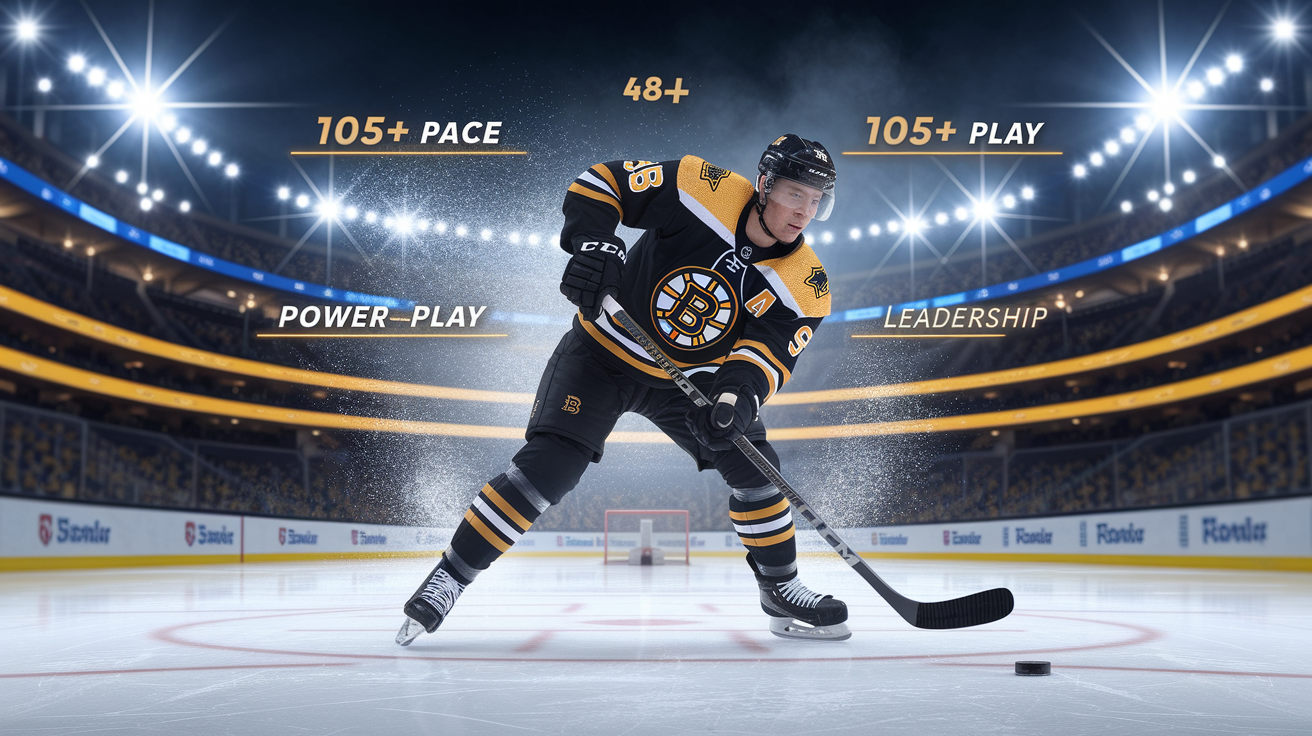
David Pastrnak’s posted three straight seasons of 105 points or more. That level of offensive consistency? Fewer than a handful of NHL players maintain it. He finished fourth in league scoring most recently, which puts him among the sport’s elite and makes him nearly impossible to replace within Boston’s system. Teams almost never trade players producing at that rate unless the franchise is blowing everything up or the player demands out. Pastrnak hasn’t requested a trade. The Bruins remain publicly committed to building around him. His production isn’t just volume, either. He’s a power-play specialist who converts at a high rate and drives offensive zone time. The kind of impact that doesn’t show up fully in box scores but directly correlates with team success.
The cost-efficiency gap between Pastrnak’s $11.25 million AAV and the new wave of mega-contracts inflates his trade value because acquiring teams know they’re getting a discount. Kirill Kaprizov’s $17 million AAV and Connor McDavid’s $12.5 million short-term extension both signal where the market’s heading for elite forwards. Pastrnak’s long-term deal, signed before the cap surge, locks in a rate that looks better every offseason as comparables reset higher. That efficiency makes Boston less motivated to move him. And it raises the acquisition cost because other teams know they won’t be able to sign a comparable player at that price in free agency.
Why production raises acquisition cost:
- Established 105-point pace eliminates developmental risk, provides immediate offensive certainty
- Power-play production and goal-scoring consistency are harder to replace than playmaking-only forwards
- Teams trading for Pastrnak are paying not just for stats but for offensive system reliability and franchise credibility
Bruins’ Organizational Strategy and Implications for a Pastrnak Trade

Boston sits at a crossroads after going 33–39–10 and missing the playoffs for the first time since 2015–16. One bad season doesn’t automatically mean you tear it all down. Especially when the roster includes locked-in stars like Pastrnak and Charlie McAvoy, whose $9 million AAV through 2029–30 represents another favorable contract. The front office can retool around those two by adding complementary depth and addressing weaknesses in goal and on defense. Or they can accept a longer rebuild by moving high-value assets for futures. The decision depends on whether management believes the core can still compete in a shortened window, or if the supporting cast has aged out beyond repair.
Keeping Pastrnak fits with long-term roster planning because his contract runs through 2030–31. That gives Boston six more seasons to build around him. The internal cap hierarchy already reflects that commitment. Pastrnak and McAvoy are the two highest-paid players, and both deals are structured to leave room for supporting pieces as the cap rises. Trading Pastrnak would create immediate cap space, sure. But it would also eliminate the team’s offensive identity and leave a void that can’t be filled by committee. The Bruins would need to replace not only his points but his leadership and marketability, which carries weight in a traditional hockey market like Boston. Keeping him lets the front office make smaller, targeted moves rather than starting from scratch.
A full rebuild would mean moving multiple veterans, not just Pastrnak. And accepting years of losing to pile up draft capital and develop prospects. That path makes sense for teams with no clear contention window. But Boston’s infrastructure (ownership, fanbase, market expectations) doesn’t tolerate extended rebuild timelines well. The Bruins are more likely to pursue a retool that keeps Pastrnak in place, adds younger talent through trades and the draft, and bets on the cap rising enough to support both core players and reinforcements. Trading a franchise cornerstone signals surrender. And unless the return overwhelmingly accelerates a rebuild, Boston’s organizational strategy leans toward keeping him.
Final Words
We ran the math. Pastrnak’s $11.25M AAV, long-term deal, and elite scoring mean any trade would need a huge return.
The Bruins’ missed season leaves them at a crossroads — retool around him or demand an overwhelming package to even consider moving a franchise cornerstone.
Bottom line, David Pastrnak trade feasibility and salary cap hurdles keep this mostly theoretical unless Boston decides to pivot. A rising cap and an overeager buyer could change things, so keep watching with cautious optimism.
FAQ
Q: What is David Pastrnak’s cap salary / How much does David Pastrnak make?
A: David Pastrnak’s cap hit and annual salary are $11.25 million per season (AAV), on an eight-year, $90 million deal signed in 2023 that runs through 2030–31.
Q: Why is CapFriendly shutting down?
A: CapFriendly is reportedly shutting down because its operators cited sustainability and resource constraints, though detailed official reasons have not been publicly released.
Q: How fast can Pastrnak skate?
A: David Pastrnak skates at an NHL-elite pace, routinely hitting top-game speeds in the high teens to low 20s mph (roughly 30–34 km/h), making him dangerous on rushes.