


Who could actually land Cale Makar — and at what cost?
Short answer: an enormous haul.
You’re talking one established top-pair NHL player, two top-10 prospects, and at least two unprotected first-round picks, plus salary help or retention.
That’s the realistic floor to get Colorado’s attention.
Even that package reads like a starting bid, not a done deal, because Makar is under contract, in his prime, and basically untouchable unless the Avalanche choose to rebuild.
Immediate Answer: The Core Trade Package Required to Acquire Cale Makar

Getting Cale Makar out of Colorado would take one of the biggest trade hauls in modern NHL history. You’re looking at multiple blue-chip pieces right off the bat: at least one legit top-pair NHL player making somewhere between $3 and $7 million, two prospects from the top ten in your system, and a minimum of two first-round picks spread across the next couple years. And that’s just to get Colorado’s attention. They’d almost definitely want more on top. Another first rounder. A second-tier prospect. Maybe conditional picks tied to how far you go in the playoffs.
The price tag reflects what Makar actually is. Two-time Norris winner signed through 2026-27 at $9 million per year. That gives whoever trades for him four-plus years of locked-in cost on a generational talent. His cap hit sits around 11 percent of the ceiling, which is manageable for a guy who runs your power play, drives offense, and eats minutes against the other team’s best players. Reports from December 2025 say league execs and player agents expect his next contract to blow past what anyone thought even a year ago. So his trade value isn’t just about what he does now. It’s about what he’ll cost later.
Here’s what a realistic starting offer looks like:
- One NHL roster player who can actually play, top pair or top six caliber, with a cap hit that helps offset the $9 million you’re taking on
- Two top-ten prospects from your system, and at least one better be a former first rounder
- Two unprotected first-round picks in back-to-back or near-consecutive drafts
- One more high-value piece, whether that’s a second rounder, another prospect in your organizational top 20, or a conditional pick tied to team or player performance
- Salary retention or a third-party middleman if you can’t fit the full $9 million right away
Even if you put all that together, there’s no guarantee Colorado answers the phone. Teams don’t move franchise cornerstones who are still under contract, still wearing letters, still winning trophies. Makar came back from a brief upper-body issue in late March and early April 2026 without missing a beat, and Team Canada named him an assistant captain in February. Unless the Avalanche blow everything up, which hasn’t even been whispered about, the odds of Makar actually being available are basically zero.
Contract Structure and How It Sets Makar’s Baseline Trade Cost

Cale Makar signed his current six-year, $54 million deal on July 24, 2021. It carries a $9 million average annual value and runs through the end of the 2026-27 season, when he hits unrestricted free agency. When the deal kicked in, that $9 million represented just over 11 percent of the league-wide cap, a premium number you only see with elite players who do everything: produce offense, play defense, log massive minutes. The contract doesn’t include any publicly reported no-trade or no-movement protection, which technically means Colorado could explore moving him. But the franchise has given zero indication it would even consider it.
The length and setup of Makar’s contract create a specific trade situation. He’s under team control through 2026-27, so whoever acquires him gets more than four years of prime performance. They also get the exclusive window to negotiate an extension starting July 1, 2026. Early reporting from December 2025 suggests agents and front offices already think his next deal will land way above what anyone projected even recently. That expected jump changes the trade math. You’re not just acquiring the current contract. You’re committing to negotiate a record-setting extension within months of getting him, which means the cost of the trade has to factor in both the assets you give up and the long-term money coming after.
| Contract Detail | Value | Trade Impact |
|---|---|---|
| AAV | $9,000,000 | Acquiring team must clear or absorb $9M in cap space immediately |
| Term Remaining | Through 2026–27 season | Four-plus years of cost certainty before UFA status pushes asset demand higher |
| Cap % Examples | ~11% (based on year-one cap ceiling) | Similar to other franchise defensemen; low enough to fit on contenders if you plan carefully |
Historical Comparables for Evaluating What It Takes to Trade for a Top Defenseman
Finding a real comp for a Cale Makar trade is nearly impossible. Players this good almost never get moved while they’re under contract and performing at Norris levels. The rare mega-deals involving elite defensemen usually happen when the player’s older, heading to unrestricted free agency soon, or part of a team-directed teardown. None of that applies to Makar. He’s signed long term, in his prime, playing for a contender. But looking at recent blockbusters involving top-pair guys gives you a rough idea of what Colorado would ask for.
When teams have traded Norris-caliber or perennial all-star defensemen lately, the return packages always include multiple premium pieces. You expect at minimum one NHL-ready player who steps in right away, at least one high-end prospect who could become a core guy within two or three years, and multiple first-round picks to refill the pipeline. The exact mix changes based on age, contract status, and where the trading team’s at competitively. But the framework stays the same. GMs use these deals as baselines when they value their own stars, even though no two situations match up perfectly.
The problem with applying past deals to Makar is most of those comps involve players with shorter contract windows or less leverage. Makar’s combo of youth, contract length, hardware, and actual on-ice value pushes his price into territory nobody’s really charted before. Teams trying to build a realistic offer would need to study the richest defenseman trades of the last decade and then add more on top. None of those deals involved someone with Makar’s full profile. That’s why analysts and execs pretty much universally call him untouchable.
What history tells us about Makar’s hypothetical value:
- Trades for Norris-winner defensemen have historically brought back at least two first rounders plus one top prospect, even when the player didn’t have much contract control left
- Younger elite defensemen moved in their prime usually command an extra roster player to offset the immediate competitive hit, which drives total package value even higher
- Blockbuster trades in the modern cap era show GMs want flexibility, demanding unprotected picks and prospects with clear top-six or top-pair ceilings instead of depth filler
- No recent deal has moved a defenseman of Makar’s age and contract status while his team stayed in contention, meaning past precedent underprices what he’d actually cost
Three Hypothetical Trade Packages a Team Might Offer for Cale Makar
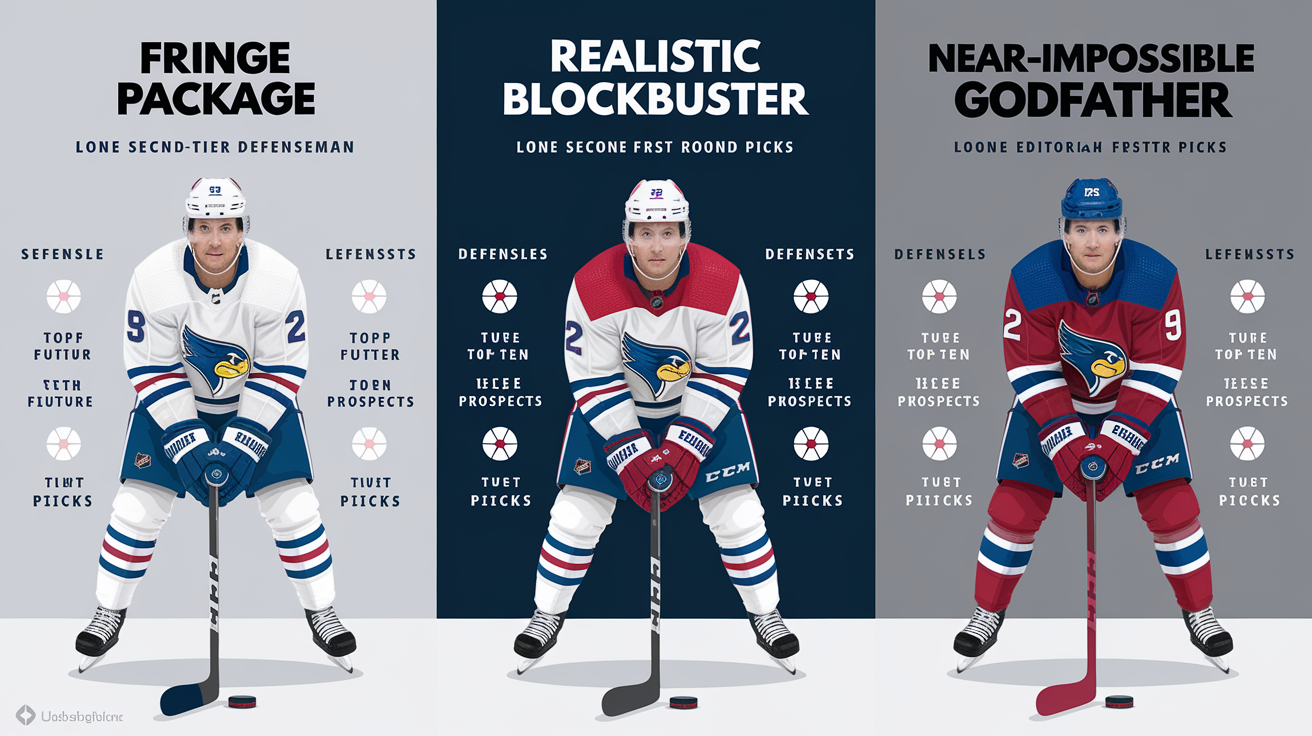
Fringe Package (Not Enough)
- One second-tier NHL defenseman with a cap hit around $4 to $5 million, useful but not a real top-pair anchor on a contender
- One first-round pick in the next two years, unprotected but not from a team projected to pick in the lottery
- Two B-level prospects ranked between 11th and 20th in your system, both with NHL upside but neither projected as stars
- One conditional second rounder tied to performance stuff like playoff rounds won or Makar’s games played
This gets rejected almost immediately. It includes multiple assets, sure. But none of them carry the premium value Colorado needs to give up a franchise cornerstone. The NHL roster piece doesn’t replace what Makar does, the single first falls way short of the multiple high picks you see in superstar trades, and the prospects don’t have the top-ten pedigree that signals future All-Star potential. Conditional picks add a little sweetener but don’t move the needle on a deal this big. A fringe offer like this might work for a deadline rental or a strong secondary piece. It doesn’t come close to Makar’s actual market value.
Realistic Blockbuster Package
- One established top-pair NHL player, either a defenseman who logs 22-plus minutes or a dynamic forward with a cap hit between $5 and $7 million who gives immediate roster help
- Two top-ten organizational prospects, and at least one better be a first-round pick who projects as a future top-line or top-pair contributor within two or three years
- Two unprotected first-round picks in consecutive or near-consecutive years, no lottery protection, giving Colorado high-value draft capital to restock
- One more high-value piece like a second rounder, a prospect ranked 11th to 15th in your system, or a conditional first tied to playoff success or Makar’s extension
This is the floor for any real Makar conversation. The package balances immediate help, future star potential, and draft flexibility. The NHL roster player keeps Colorado from collapsing defensively or offensively short term, the top prospects give them pathways to replace Makar’s long-term value, and the multiple firsts create options in future drafts. Even at this level, Colorado scrutinizes every piece. Trading Makar means accepting no single return matches his individual impact. The acquiring team needs to clear roughly $9 million in cap space to fit his contract, which probably requires roster moves or salary retention through a third party.
Near-Impossible Godfather Package
- Two roster NHL players, one top-pair defenseman or top-line forward and one strong secondary piece, combining for $8 to $12 million in outgoing cap that helps Colorado rebalance right away
- Three top-ten prospects, including at least two recent first-round picks and one blue-chip talent ranked inside the top five of your organizational depth chart
- Three unprotected first-round picks across the next four years, giving Colorado multiple high selections in consecutive drafts to speed up a potential rebuild or reload
- One more sweetener like a high second rounder, a prospect with unique upside outside the top ten, or retained salary on Makar’s contract for the whole deal if your cap structure needs it
This package represents the absolute ceiling of what a desperate or cap-rich team might throw out to pry Makar loose. It guts your prospect pool, draft capital, and roster depth. But it reflects reality. Franchise defensemen almost never become available. Even an offer this massive doesn’t guarantee Colorado says yes. The Avalanche would need to believe the return sets them up for sustained contention or a successful rebuild, and they’d catch hell from fans and media if Makar stays elite after the trade. Only a fundamental shift in organizational direction or some irreconcilable contract dispute would make Colorado even think about a package at this level.
Cap Maneuvering and Roster-Building Challenges for Teams Trying to Fit Makar’s Contract
Taking on Cale Makar’s $9 million cap hit requires more than just having space on paper. Teams either need to carry enough flexibility heading into the trade, dump salary to create room, or structure the deal with retention or third-party help to cut the immediate financial load. Timing matters a lot. A trade in the offseason lets you use buyouts, non-tender decisions, and UFA departures to clear space. A deadline deal offers way less flexibility. You’re forced to move roster players in real time or lean on long-term injury reserve to temporarily dodge the cap.
There are downstream consequences too. Committing $9 million to one player, knowing his next contract will blow past that number, limits how much you can spend everywhere else. Teams already tight against the cap might need to trade away secondary pieces, let pending free agents walk, or lean hard on entry-level deals to fill out the roster. Multi-team retention can ease the immediate cap pain by having Colorado or a third team hold part of Makar’s salary. But retention slots are limited, and using one on a long-term contract cuts into future flexibility. If you’re going after Makar, you can’t just plan for the year you get him. You need to plan for the extension that follows, when his cap hit could jump into double digits.
| Scenario | Cap Space Needed | Time of Year |
|---|---|---|
| Deadline Acquisition | Full $9M or retained portion (~$4.5M with 50% retention) | Mid-season; requires immediate roster moves or LTIR usage |
| Offseason Acquisition | Full $9M; easier to clear via buyouts and UFA departures | July 1 onward; maximum roster flexibility |
| LTIR Maneuvering | Makar’s cap hit absorbed if team has equivalent LTIR pool | Any time; depends on injured player’s contract and timeline |
| Multi-Team Retention | Reduced to ~$6M or lower with two retaining parties | Any time; requires third team willing to hold salary long-term |
| Roster Salary Dump | Trade out $5M to $10M in existing contracts to create room | Offseason or deadline; might require attaching picks to move contracts |
Evaluating Colorado’s Likelihood of Trading Makar
Colorado hasn’t shown any sign Makar’s available. Every indicator points toward the Avalanche building around him for years. The team’s still competing through at least the 2026 season, with Makar as the anchor of the blue line and the power play. His leadership got reinforced in February 2026 when Team Canada named him an assistant captain. His two Norris wins prove he’s one of the most dominant players in the league. Teams in that spot don’t trade their best player unless they’re facing financial collapse, a relationship blowup, or a full organizational reset. None of that applies here.
The timeline of Makar’s contract also favors keeping him. He’s under control through 2026-27, and Colorado can start extension talks after July 1, 2026. The franchise already signaled its intent to build around him by prioritizing cost-controlled defensive depth. They drafted Francesco Dell’Elce and Linus Funck with two of their top three picks, and they signed Zakhar Bardakov to an entry-level deal in April. Those moves show a strategy to surround Makar with affordable young talent instead of cashing in on his value and rebuilding. Colorado also created cap space by trading Charlie Coyle and Miles Wood to Columbus, keeping the team competitive while leaving room for Makar’s extension.
The public relations nightmare alone makes a Makar trade nearly unthinkable. If Colorado moved him while he’s healthy, productive, and under contract, the backlash would be brutal. The franchise won a Stanley Cup with him anchoring the defense. His injury in late March and early April 2026 was minor enough that he came back for the postseason without any lingering issues. Unless the Avalanche suffer a total collapse or Makar requests out, which hasn’t been reported anywhere credible, the front office has zero reason to explore trade scenarios. Fans expect the team to extend him. Not flip him for assets.
Analyst and Front-Office Consensus on the Realistic Odds of Acquiring Makar

League-wide, Cale Makar’s treated as one of the most untouchable players in hockey. When agents and front-office people got surveyed in December 2025, basically everyone said they expect his next contract to exceed earlier projections. Nobody suggested Colorado has any interest in moving him. The mix of his age, contract control, hardware, and on-ice impact creates a price tag so high that even teams ready to offer blockbuster packages would struggle to meet what Colorado wants. Execs who’ve been part of mega-deal talks before admit trading someone like Makar requires organizational buy-in and a real strategic reason. Neither exists in Denver.
Analysts agree on two scenarios that could change things. First is a fundamental organizational reset triggered by ownership change, management turnover, or a multi-year competitive slide that forces Colorado to rebuild from scratch. Second is some kind of relationship breakdown between Makar and the franchise. Contract dispute, trade request, off-ice conflict that makes keeping him impossible. Neither scenario has happened or been credibly reported. Until one of those conditions shows up, the realistic odds of acquiring Makar sit somewhere between highly unlikely and basically impossible.
What experts keep saying:
- Makar’s contract length, performance, and leadership make him a franchise piece Colorado has no reason to move
- Any real package would need multiple premium assets, and even then Colorado probably declines unless the organization’s in upheaval
- Teams wanting a player of Makar’s caliber should focus on stars nearing free agency or on teams already rebuilding, because contenders don’t trade their best players under contract
Final Words
In the action, acquiring Cale Makar would demand a franchise-level haul: multiple first-round picks, at least one top prospect, a top-pair NHL player and clear cap space.
We laid out the contract baseline, historical comparables, three escalating packages and the cap maneuvers teams must pull off. Colorado looks unlikely to move him unless a full reset or locker-room issue forces the hand.
For teams still asking what would it take to acquire Cale Makar, expect a deal that reshapes contenders, and that prospect alone makes it fun to watch.
FAQ
Q: Why is Cale Makar so good?
A: Cale Makar is so good because he skates like a forward, drives play from the blue line, combines elite puck skills with smart defense, quarterbacks the power play, and has multiple Norris-level awards.
Q: What is Cale Makar’s salary cap?
A: Cale Makar’s salary cap hit is $9 million AAV on a six-year, $54 million contract through 2026–27, representing roughly 11% of the salary cap in the first year.
Q: What draft pick was Cale Makar?
A: Cale Makar was the fourth overall pick in the 2017 NHL Draft, selected by the Colorado Avalanche as a top defensive prospect expected to contribute immediately.
Q: Is Taylor Makar Cale Makar’s brother?
A: Yes. Taylor Makar is Cale Makar’s older brother, and both progressed through Alberta junior hockey programs before Cale broke into the NHL.