

The best player overall isn’t always the boss in direct matchups.
Statistical rivalries strip away teams and headlines to show who wins when two greats face off.
We dig into win‑loss records, surface or situational splits, clutch metrics, and streaks across sports to name the true matchup winners.
Expect clear rules for spotting dominance, plus surprising names who own certain opponents despite not being the sport’s top star.
We’ll explain why.
Head‑to‑Head Matchups Explained Through Statistical Rivalries
Statistical rivalries get measured by digging into repeated matchups between elite players. You’re looking at win-loss records, performance data, and the context around each meeting to figure out who really holds the edge. When Novak Djokovic and Rafael Nadal met for the 60th time at the 2024 Paris Olympics and Djokovic won to pull ahead 31-29, that single match shifted a two-decade story built on clay dominance, hard-court adjustments, and Grand Slam finals. Head-to-head matchups strip away team influence. They isolate individual superiority across time, surfaces, and competitive stages.
Win-loss ratios are the foundation. But modern analysis layers efficiency metrics, clutch performance, and timeline context on top. Djokovic’s 27-23 advantage over Roger Federer is more than just numbers. It includes 12 Grand Slam encounters split evenly, a 47.2% trailing-win rate that’s the highest among rivalries with 25+ meetings, and a pattern where neither player won more than three straight matches. Before the Open Era began in 1968, Pancho Gonzales defeated Ken Rosewall 117-87 across 204 meetings. Rod Laver went 89-75 against Rosewall overall and dominated finals 36-20. These numbers show how volume, consistency, and situational performance combine to define dominance.
Fans evaluating player vs player superiority typically examine five core metrics. Overall win-loss ratio and whether it favors one player by a statistically significant margin. Performance in high-stakes settings like finals, playoffs, Grand Slams, title-deciding games. Head-to-head splits across different conditions such as surface, venue, home-away, era. Streak patterns showing sustained dominance or momentum shifts. And efficiency plus closeness indicators like blowout rate, comeback wins, games-left-on-table averages.
| Player Rivalry | Total Meetings | Overall Record |
|---|---|---|
| Djokovic vs Nadal | 60 | Djokovic 31–29 |
| Djokovic vs Federer | 50 | Djokovic 27–23 |
| Gonzales vs Rosewall (pre-Open Era) | 204 | Gonzales 117–87 |
Statistical Rivalries Across Sports and Why Certain Players Dominate
Prime years, physical decline, tactical evolution, and injury windows dictate which player controls a rivalry at any given moment. Rafael Nadal won 14 of his first 18 meetings with Djokovic between 2006 and early 2011, building a reputation as the matchup favorite. Then Djokovic overhauled his fitness, sharpened his return, and captured 15 of their next 24 encounters. The long-term balance flipped. Roger Federer held a 13-6 lead over Djokovic at one point. But Djokovic closed the gap and eventually took a 27-23 overall edge as Federer aged and Djokovic entered his peak years.
Jimmy Connors led Ivan Lendl 13-5 in their rivalry through 1984, then lost the final 17 meetings in a row as Lendl refined his baseline power game and Connors’ athleticism faded. John McEnroe surged past Connors with 11 consecutive victories from 1983 to 1986, cementing a 20-14 final record after years of tight exchanges. The Federer-Djokovic rivalry stands out for balance. Neither man strung together more than three wins in succession, a rarity among 50-match samples. Timing matters as much as talent when rivalry outcomes shift over a decade or more.
Playing-style matchups amplify or neutralize individual strengths. Nadal’s heavy topspin troubled Federer’s single-handed backhand on clay, producing a 14-2 surface record for Nadal. Federer’s low-bounce slice and aggressive net play gave him a 3-1 edge on grass. Djokovic’s superior return of serve and baseline defense counteracted Federer’s aggressive first-strike tennis on hard courts, where Djokovic leads 20-18 despite Federer’s early dominance. In football, coaching systems, supporting teammates, and tactical instructions shape individual duels. Lionel Messi and Cristiano Ronaldo faced different league defenses, club philosophies, and national-team contexts that colored their head-to-head encounters at club and international levels.
Performance Metrics That Reveal Dominance in Head‑to‑Head Matchups

Raw win-loss counts can mask the texture of a rivalry if one player consistently wins in straight sets or blowouts while the other keeps matches tight. Advanced analytics drill into game closeness, efficiency, and clutch execution to reveal whether dominance is absolute or contested. The Federer-Djokovic rivalry produced 33.3% of sets finishing 7-5 or closer, the highest rate among matchups with 25+ meetings, and a straight-set rate of just 47%, well below the 58% average for frequent rivalries. Those numbers show competitive balance hidden inside Djokovic’s 27-23 edge.
Eight performance metrics clarify true dominance in head-to-head matchups.
Trailing-player win percentage. Djokovic’s 47.2% success rate while trailing Federer in the overall count is the best among rivalries with 25+ meetings, signaling competitiveness even in deficit.
Percent of possible sets played. Federer-Djokovic reached 77.6% of maximum sets (e.g., four sets in a best-of-five), above the 75% benchmark for frequent rivalries.
Games-left-on-table average. Lower scores indicate tighter sets. Federer-Djokovic averaged 1.47 games per set versus a typical 1.73.
Close-set frequency. Percentage of sets decided 7-5, 7-6, or tighter. One-third of Federer-Djokovic sets hit that threshold.
Comeback-win rate. Matches won after trailing by a set. Federer-Djokovic posted 22.2%, near the 25% average for elite matchups.
Straight-set “dud” rate. Matches ending in straight sets with no close set (no set 7-5 or tighter). Federer-Djokovic logged 14% duds compared to 33% rivalry average.
Points-per-game or per-possession efficiency. Common in basketball and football, revealing scoring output and defensive stops in direct matchups.
Usage rate and assist-to-turnover ratio. Shows which player controlled tempo and made fewer mistakes in critical moments.
Federer-Djokovic analytics uncovered a rivalry defined by razor-thin margins despite a four-match Djokovic lead. That 1.47 games left on the table per set tells the story of precision and parity that simple win totals obscure.
Historic and Era‑Defining Statistical Rivalries

Certain rivalries transcend individual records to define entire eras of their sport, reshaping fan expectations and strategic norms. Roger Federer and Rafael Nadal met 40 times with Nadal winning 24-16 overall, including 20 finals, double the final count of Federer-Djokovic, and a 14-10 edge in those championship matches. Nadal’s 14-2 clay dominance forced Federer to rethink baseline positioning and shot selection. Federer’s 3-1 grass record and 11-9 hard-court edge demonstrated adaptability. That rivalry set the template for surface-specific supremacy and cross-surface tactical evolution in the 2000s.
The Djokovic-Nadal 60-meeting marathon stands as the Open Era’s most frequent pairing, producing seven major finals between September 2010 and mid-2014 alone. Ivan Lendl and John McEnroe played 36 times with Lendl winning 21-15 overall and 7-3 at Grand Slams, including the final six consecutive encounters, a closing run that cemented Lendl’s late-career dominance. Pete Sampras led Andre Agassi 20-14 across 34 meetings and claimed four of their five Grand Slam finals, defining American tennis in the 1990s. Each rivalry shaped not only their own legacies but also the competitive architecture of their sport.
Examples of Era‑Defining Numbers
Boris Becker defeated Stefan Edberg 25-10 across 35 career meetings, a commanding 71.4% winning record, yet Edberg won three of their four Grand Slam encounters. That shows how major-tournament clutch performance can overshadow head-to-head volume. Nadal’s 14-2 clay record against Federer, including 4-0 in French Open finals, redefined clay-court excellence and forced analysts to separate surface dominance from all-conditions greatness. McEnroe’s 11 straight wins over Connors from 1983 to 1986 marked the sharpest momentum swing in any top-tier rivalry with 25+ meetings, proving that streaks can permanently redefine competitive narratives even when overall records remain relatively close. For more context on the men’s greatest head-to-head rivalries in tennis, analysts use both volume and Grand Slam weighting to rank historical pairings.
How Win‑Loss Ratios and Streak Patterns Shape Statistical Rivalries
Winning streaks turn balanced rivalries into narratives of dominance, even when final records suggest competitiveness. John McEnroe’s 20-14 advantage over Jimmy Connors includes an 11-match winning streak from 1983 to 1986 that erased earlier uncertainty and established McEnroe as the definitive late-era favorite. Connors’ 17 consecutive losses to Ivan Lendl after holding a 13-5 lead through 1984 transformed a rivalry Connors once controlled into a cautionary tale about aging and tactical stagnation. Streaks carry psychological weight. Opponents internalize patterns, fans update expectations, and media amplify momentum shifts that single-match results might not reveal.
Close games, overtime battles, and upset victories add texture beyond raw percentages. Novak Djokovic defeated Andy Murray 25-11 overall and won five of their seven major finals, but Murray’s two grass-court victories, the 2013 Wimbledon final and 2012 Olympics semi-final, remain iconic upsets that temper Djokovic’s statistical dominance. Blowout margins matter. Lendl’s 7-3 Grand Slam record over McEnroe included several straight-set victories that highlighted superior conditioning and baseline consistency. The closer the win-loss ratio and the more frequent the tight finishes, the more competitive the rivalry feels regardless of who holds the edge.
Six rivalry streak patterns reveal competitive imbalance or parity across sports. Lendl vs McEnroe saw the final six meetings all won by Lendl, cementing a 21-15 overall edge and 7-3 Grand Slam advantage. McEnroe vs Connors had 11 straight McEnroe wins (1983-1986) that turned a competitive series into a 20-14 final record. Connors vs Lendl featured 17 consecutive Lendl victories after Connors led 13-5, illustrating late-career decline. Federer vs Djokovic had no streak longer than three wins, the tightest pattern among 50-match rivalries. Sampras vs Agassi saw Sampras win four of five Grand Slam finals, establishing clutch superiority despite a 20-14 overall count. Djokovic vs Murray produced Djokovic’s 8-2 Grand Slam record including five major finals, overshadowing Murray’s two grass-court upsets.
Surface, Venue, and Game-Condition Factors in Head‑to‑Head Outcomes
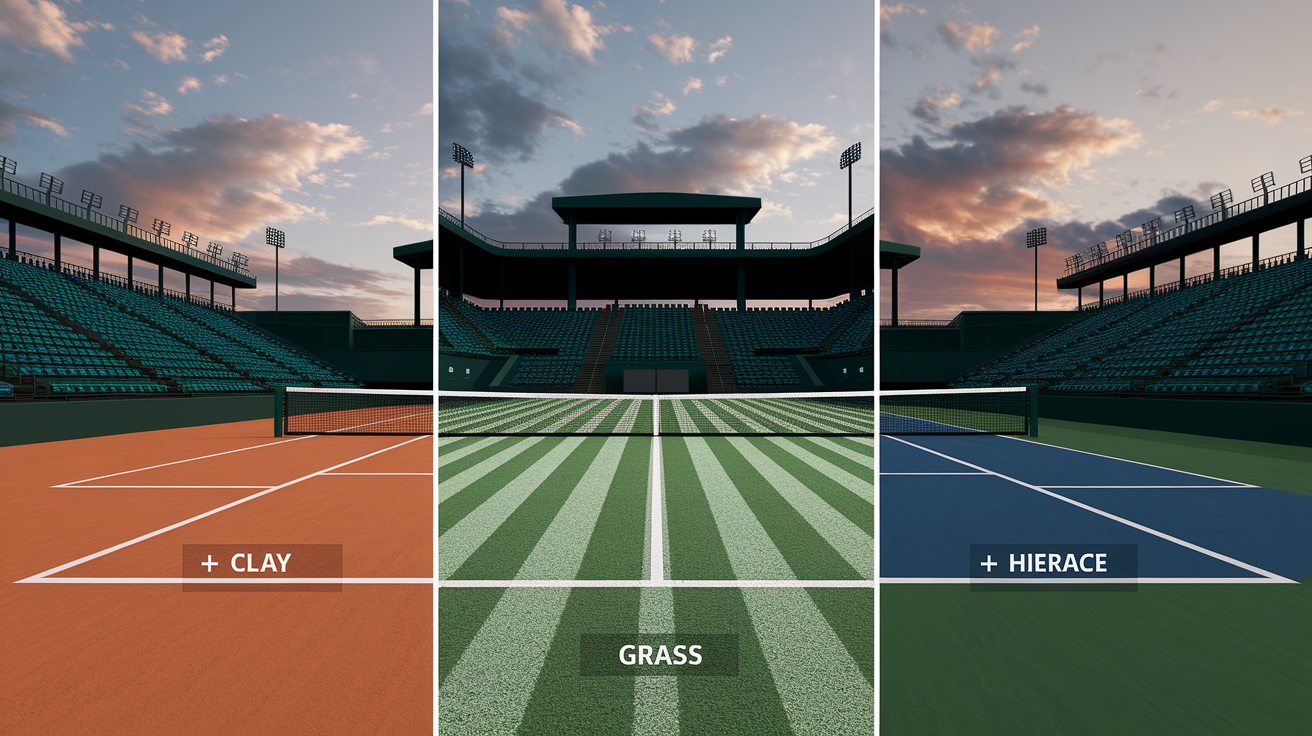
Playing conditions can invert head-to-head records and expose tactical mismatches that disappear under different circumstances. Rafael Nadal’s 14-2 clay dominance over Roger Federer stands in sharp contrast to Federer’s 3-1 grass edge and 11-9 hard-court lead. Surface characteristics like bounce height, ball speed, slide friction reshape individual matchups more than overall skill gaps. Nadal won all four French Open finals against Federer, while Federer claimed critical Wimbledon and hard-court victories that kept the 40-match rivalry from becoming one-sided despite Nadal’s 24-16 overall advantage.
Djokovic’s 20-18 hard-court edge over Federer and 3-1 grass lead reflect his ability to handle Federer’s serve-and-volley variations on faster surfaces, while both players split 4-4 on clay where conditions equalized their baseline exchanges. Andy Murray’s two grass-court wins over Djokovic, 2013 Wimbledon final and 2012 Olympics semi-final, stand out against Djokovic’s 25-11 overall dominance. Venue-specific preparation and surface familiarity can produce outlier results. Home-court advantage in football and basketball magnifies these effects. Crowd energy, travel fatigue, and referee tendencies shift win probabilities even when talent levels remain constant.
Applying Statistical Rivalry Models to Football Icons
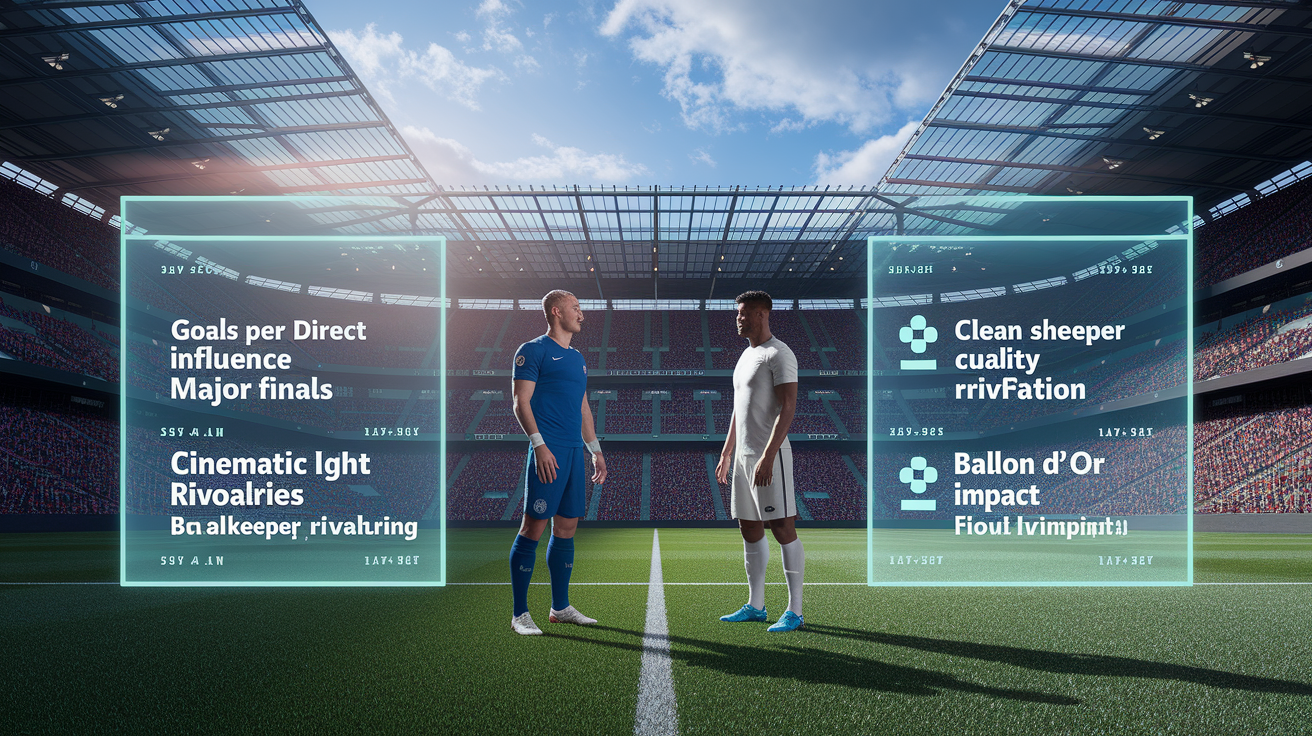
Football rivalries lack the isolated one-on-one structure of tennis but still produce measurable head-to-head metrics through goals, assists, clean sheets, and trophy counts in direct encounters. Lionel Messi and Cristiano Ronaldo claimed all ten Ballon d’Or awards from 2008 to 2017 and finished first and second in nine of those years, turning individual accolades into a proxy for competitive superiority when their clubs met. Barcelona vs Real Madrid clashes magnified the rivalry’s statistical importance, with each goal, assist, and match outcome feeding the decade-long debate over who dominated the era.
Thierry Henry won four Premier League Golden Boots while Ruud van Nistelrooy claimed one, establishing Henry’s scoring supremacy in their Arsenal-Manchester United duels. The Steven Gerrard vs Frank Lampard selection debate lasted from Euro 2004 through the 2010 World Cup, with national-team managers struggling to pair both midfielders effectively, an issue rooted in overlapping roles rather than direct head-to-head stats. Franz Beckenbauer and Johan Cruyff faced each other just four times, yet their 1974 World Cup final encounter and contrasting tactical philosophies (Beckenbauer’s libero vs Cruyff’s Total Football) made the rivalry era-defining despite limited sample size. Longevity, mutual impact on major finals, and public discourse often matter more in football than sheer meeting frequency.
Contextual factors reshape football rivalry analysis compared to individual sports. National team matchups depend on squad quality, coaching strategies, and tournament draw luck, factors outside individual control. Tactical roles shift with formations. A forward might face different defensive assignments across seasons, complicating per-game comparisons. Longevity in football spans club and international competitions, trophy hauls, and peer recognition (Ballon d’Or votes, PFA awards), broadening the statistical lens beyond direct encounters. Supporting casts matter. Messi’s chemistry with Xavi and Iniesta versus Ronaldo’s interplay with Benzema and Modric shaped their Clásico performances and goal tallies in ways isolated metrics struggle to capture. For a deeper look at how these dynamics play out, analysts often reference rankings of the greatest player rivalries in football history.
Four football-specific metrics clarify dominance in player rivalries. Goals per direct encounter tracks scoring output when rivals face each other, isolating individual impact in shared matches. Influence in major finals counts decisive goals, assists, and man-of-the-match awards in Champions League, World Cup, or domestic cup finals. Clean sheets for goalkeeper rivalries measures shutout frequency and save percentage in head-to-head national-team or club meetings. Ballon d’Or and individual-award impact quantifies peer and media recognition during overlapping career peaks, serving as a proxy for dominance perception.
Final Words
In the action we broke down how head-to-head numbers tell the story: win-loss ratios, points per game, efficiency, streaks, and surface or venue splits.
We used tennis and football examples — Djokovic–Nadal, Federer–Djokovic, Nadal–Federer and Messi–Ronaldo — to show how context can flip who looks dominant.
Quick checklist: win-loss, close-set or close-game rate, comeback percentage, venue split, and impact in big matches.
Statistical rivalries: which players dominate head-to-head matchups should be a tool, not a headline. Use it to spot trends and enjoy the next chapter.
FAQ
Q: What is the fiercest rivalry in sports? / What is the greatest rivalry in history?
A: The fiercest or greatest rivalry in sports history depends on sport and era, with common picks like Yankees–Red Sox, Real Madrid–Barcelona, and Federer vs Nadal/Djokovic, judged by intensity, history, and fan passion.
Q: What two tennis players have played each other the most?
A: The two tennis players who’ve played each other the most are Novak Djokovic and Rafael Nadal, meeting 60 times from 2006 to 2024, with Djokovic leading 31–29.
Q: What is the #1 rivalry in the NFL?
A: The number one rivalry in the NFL is often the Bears vs Packers matchup, the league’s oldest and most storied rivalry, though rankings can change by era or criteria.