

Which way will the Red Sox go this winter, a splashy left fielder and a lottery-ticket starter, or cheap depth and a stopgap arm?
Multiple reports say Boston is focused on filling everyday left field and adding a 100-140 inning mid-rotation starter.
This piece lays out the top targets linked to the club, why each fits the roster profile, and the trade-offs the front office faces as rivals bid.
If you want the realistic best- and worst-case outcomes, read on.
Latest Free Agency Rumors and Leading Red Sox Targets

Boston’s floating around the middle and upper tiers of free agency this winter, according to multiple league sources. The chatter lately centers on two gaps they’re trying to fill: an everyday left fielder and a pitcher who can log 100 to 140 innings somewhere in the middle of the rotation. Left field needs someone who can handle 350 to 450 plate appearances. The back of the rotation could use another 100 to 150 innings if nobody gets promoted from within.
Over the past couple weeks, the same handful of names keep popping up. On offense, they’re looking at corner outfielders who can actually field, walk at least 8 percent of the time, and show some pop. For pitching, they want mid-rotation veterans between 27 and 34 who threw at least 100 innings last year and posted FIP numbers within half a run of their ERA. Problem is, other AL East clubs and a few National League contenders are chasing the same guys. That’s putting pressure on Boston’s timeline.
Five players sit at the top of their free agent board, based on what’s been corroborated across multiple outlets. It’s a mix of short-term prove-it deals and longer commitments:
- Dylan Cease – only pitcher in baseball with 200-plus strikeouts each of the last five seasons. Elite strikeout stuff, but his run prevention jumps around year to year.
- Framber Valdez – two-time All-Star with a solid track record, though he struggled in the second half of 2025 and reportedly had communication issues with his catcher. That’s raising questions about what he’ll actually cost.
- Tatsuya Imai – 27-year-old lefty who’s never thrown a big league pitch. No qualifying offer attached. Might end up being the most expensive rotation target because he’s young and there’s no draft pick compensation.
- Ranger Suárez – 30-year-old southpaw coming off a 4.7 WAR season with a 3.20 ERA. Contract projections range from five years at $146M to six years around $161.5M.
- Freddy Peralta – posted a 2.70 ERA and 5.5 WAR in 2025. He’s available through a trade-and-extend path, with just $8M owed in 2026 before he hits free agency in 2027.
Evaluating the Left-Field Market and Boston’s Ideal Profile

Boston’s left field search comes down to two things: defense and getting on base. They’ve got power elsewhere in the lineup, so evaluators can prioritize glove work and plate discipline over pure slugging. Scouts want someone who can cover left field with above-average range and arm strength, walk close to or above 8 percent, and keep their OPS near .780 or better.
The current free agent market splits into two groups. First, there are veteran power hitters in their early 30s looking for two to four years, usually priced between $30M and $80M total. These guys bring proven offense but might be declining defensively or lack positional flexibility. Then you’ve got younger, defense-first outfielders willing to take one or two year deals in the $4M to $15M annual range. These are prove-it profiles: strong defensive metrics, solid but unspectacular offense. Low-risk additions.
Boston’s internal evaluations lean toward candidates who can step right into 350 to 450 plate appearances without needing a platoon partner. Recent analytics benchmarks show they’re targeting a three-year weighted runs created plus of at least 110, which signals above-average offense, plus positive defensive runs saved. Players who check both boxes give Boston what they need: everyday reliability in the field and enough offense to avoid creating a lineup hole.
Rotation Depth Priorities and Pitchers on Boston’s Radar
The rotation search has zeroed in on veterans who can eat innings without demanding ace money or costing top prospects. Boston’s front office has said they prefer pitchers who bring durability (at least 100 innings in 2024) and enough swing-and-miss ability to keep strikeout rates near or above league average. This reflects lessons from recent seasons, when shaky back-end starters forced the bullpen into unsustainable workloads.
| Pitcher | Skill Strength | Fit for Boston |
|---|---|---|
| Dylan Cease | Elite strikeout volume (200+ K five straight years) | High upside as No. 2 starter; volatility may require flexible rotation role |
| Framber Valdez | Proven durability and All-Star résumé | Steady innings-eater for middle rotation; 2025 second-half collapse raises questions |
| Tatsuya Imai | Young lefty with no MLB track record or qualifying offer | Highest risk/reward; likely expensive for unproven commodity |
| Freddy Peralta | 2.70 ERA, 5.5 WAR in 2025; strong strikeout-to-walk ratio | Trade-and-extend candidate; low 2026 cost but requires asset surrender |
These four pitchers represent different strategic paths. Cease gives you pure swing-and-miss dominance but you’re accepting year-to-year inconsistency. Valdez provides a safer floor with postseason experience, though his late-season struggles and that reported catcher communication issue introduce some uncertainty. Imai’s the wildcard: younger arm with zero major league history. Could be a bargain or an expensive learning curve. Peralta sits at the intersection of performance and cost efficiency. Getting him means surrendering prospects or outfield depth, but his 2026 salary is only $8 million and Boston could work out an extension before he reaches free agency in 2027. Each option forces a tradeoff between financial commitment, roster flexibility, and how much risk you’re willing to take on.
Projected Contract Ranges and Payroll Strategy

Contract forecasts for the top targets break down into tiers. At the high end, Ranger Suárez is projected to land either five years around $146 million (AAV $29.2M) or six years near $161.5 million (AAV $26.9M). The inverse relationship between term and average annual value is typical. Shorter deals push the AAV higher to make up for less security. Longer commitments spread the cost across more seasons. Framber Valdez and Dylan Cease are expected to land in a similar range, though Valdez’s second-half decline might shave $10M to $20M off his total guarantee.
Mid-market rotation depth signings usually fall into the $12M to $45M total range, structured as one to three year deals. These contracts let teams add reliable innings without blocking future payroll flexibility or committing to long-term risk. For left field, veteran power hitters are projected to seek $10M to $25M per year on two to four year deals, while shorter-term defensive specialists can be signed for $4M to $15M annually. Boston’s current payroll position and luxury tax considerations leave room for one major multi-year addition plus several value-driven depth pieces, as long as the front office balances term carefully.
The club’s broader financial strategy seems to favor controllable, short-term deals that preserve optionality. Key contract tier comparisons:
- High-end rotation: 5 to 6 years, $140M to $160M total. Targets premium No. 2 starters with proven track records.
- Mid-market rotation: 1 to 3 years, $12M to $45M total. Secures reliable innings without blocking future flexibility.
- Value plays: 1-year prove-it deals at $2M to $10M. Low-cost upside bets on bounce-back candidates or defensive specialists.
Rival Teams Competing for Similar Players
Several American League East clubs are chasing the same group of left fielders and mid-rotation arms, creating direct bidding competition that could push prices up by 10 to 40 percent. The Orioles, Yankees, and Astros have all been tied to Freddy Peralta, and San Francisco’s in the mix too. Each of these teams holds a comparable or stronger prospect pool, giving them leverage in trade talks and forcing Boston to decide whether to overpay in assets or pivot to free agency.
On the free agent side, multiple National League contenders are exploring the same pitching targets. Teams with immediate playoff windows and payroll room can drive contract offers beyond Boston’s projected comfort zone, especially for Suárez and Valdez. The overlap creates urgency. Wait too long and your preferred targets sign elsewhere. Move too quickly and you might overpay before the market sets a floor.
| Team | Target Overlap | Impact on Market |
|---|---|---|
| Baltimore Orioles | Freddy Peralta (trade), mid-rotation depth | Strong farm system raises trade-cost floor; direct AL East rivalry adds urgency |
| New York Yankees | Peralta (trade), Dylan Cease, Framber Valdez | Large payroll and deep pockets can push AAV higher in free agency |
| San Francisco Giants | Peralta (trade), Tatsuya Imai | West Coast club with rotation needs; may bid aggressively for unproven international talent |
Offseason Timeline and What to Expect Next
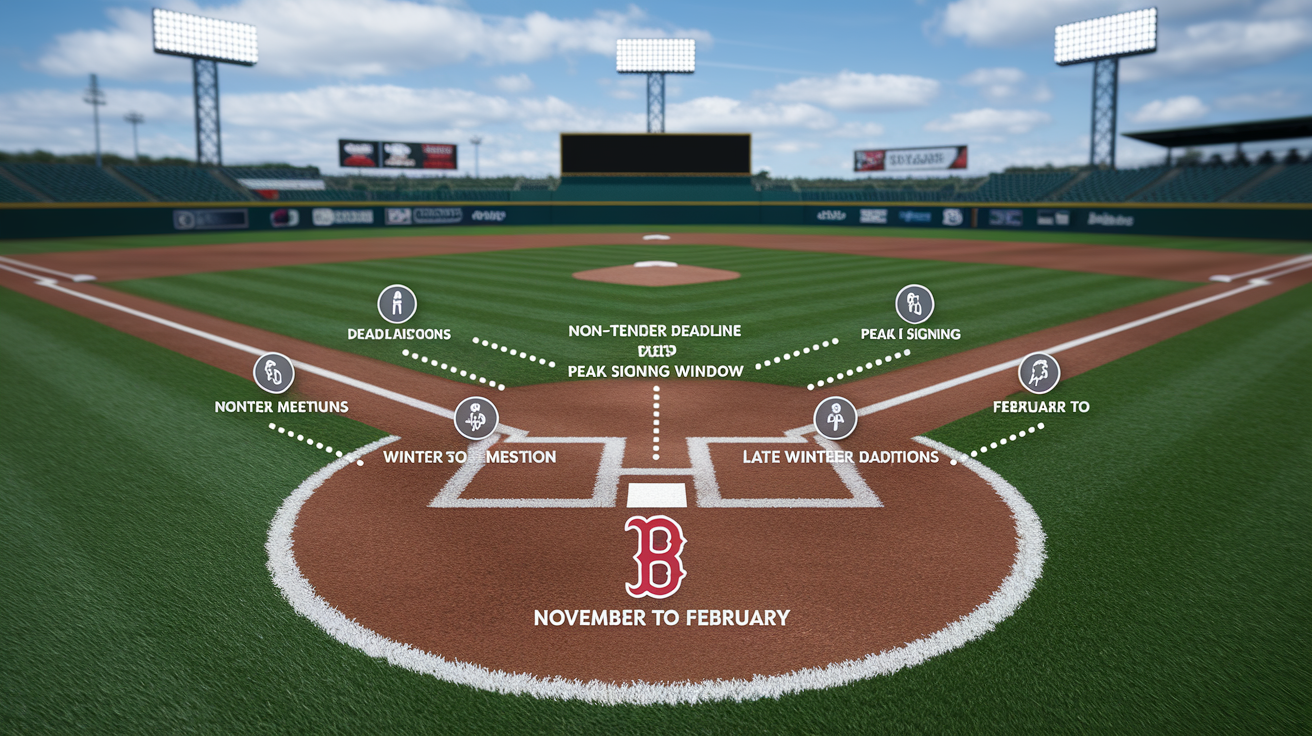
The Red Sox offseason follows a predictable but compressed calendar. Non-tender decisions and roster freezes happen in early December, giving teams clarity on which arbitration-eligible players will stick around. Winter Meetings, typically held in the first or second week of December, serve as the main deal-making hub where clubs speed up negotiations and lock in trades. Peak free agent signings cluster between mid-November and mid-December, right after the postseason ends, with smaller moves trickling into January as teams fill out the back end of rosters.
Boston’s decision-makers have said they need to act before Spring Training 2026, which puts most major moves within the next eight to twelve weeks. Recent reporting (including specific mentions dated December 10) suggests the front office is in active conversations about both Ranger Suárez and Freddy Peralta. Arbitration exchanges and hearings in late January and February will provide final payroll clarity, but waiting that long risks losing top targets to faster-moving rivals. The organization’s stated intent to “double down” on rotation upgrades ahead of 2026 signals that pitching decisions are likely to come first, with left field additions following once payroll space is defined.
Key phases of the free agency timeline:
- Non-tender deadline (early December). Teams decide which arbitration-eligible players to tender contracts. Clears roster space and payroll obligations.
- Winter Meetings (early to mid-December). Concentrated period of trade talks and free agent signings. Historically the busiest week of the offseason.
- Peak signing window (mid-November through mid-December). Top-tier free agents finalize multi-year deals. Secondary market begins to take shape.
- Late-winter depth additions (January through February). Teams fill rotation and bench depth with lower-cost veterans and minor league invites. Arbitration hearings clarify final payroll figures.
Final Words
Boston’s winter is focused on upgrading left field defense and adding innings-eating starters to the back end of the rotation.
We ran through the top whispers, who fits Boston’s defensive and on-base profile, the pitchers who bring durability, and how payroll and rival interest could shape offers.
Keep watching the timeline — Red Sox free agency whispers: top targets for left field and rotation depth point to mid-market deals and smart fits that could make Boston more stable and competitive next season.
FAQ
Q: What did David Ortiz say about Devers trade?
A: David Ortiz reportedly called the Devers trade surprising, praised Devers’ talent, and said he wished him well while noting Devers’ significant impact on Boston’s lineup and clubhouse.
Q: Does Manny Ramirez still get paid by the Red Sox?
A: Manny Ramirez is no longer on the Red Sox payroll; his playing contract ended years ago. Any remaining deferred payments would show up in public contract records, not regular team salary lists.
Q: Who are the Red Sox Big 3 prospects?
A: The Red Sox Big 3 prospects refers to the team’s top three minor-league players at a given time; names change often, so check the latest prospect rankings from trusted outlets for the current trio.
Q: What did Alex Cora say about Devers?
A: Alex Cora said he respected the decision, praised Devers’ on- and off-field contributions, wished him success, and emphasized the club’s focus on the next steps for the team.