


Think buyouts are the quick fix and trades the smarter move? It depends, and it can make or break a rebuild.
Buyouts free a roster spot and give immediate cap relief, but leave dead money hanging for years.
Trades can turn bad contracts into picks or prospects, speeding the rebuild if you find a buyer or use salary retention wisely.
This piece breaks down the real trade-offs: short-term breathing room versus long-term asset gain, when each option wins, and how general managers should time moves to actually shorten the rebuild.
Core Differences Between Buyouts and Trades in NHL Rebuilds
Teams rebuilding face a simple question when they’re stuck with underperforming or expensive contracts: take a multi-year cap penalty through a buyout and clear the roster spot now, or spend organizational resources on a trade that brings back future assets. The answer shapes your short-term cap picture, your prospect pool, how many salary retention slots you’re using, and when you can actually compete again. Rebuilding clubs care about long-term flexibility and stacking assets over winning games today, which changes the math completely compared to what contenders deal with.
Buyouts stretch the financial pain across twice the remaining contract and drop the annual cap hit. But you get zero assets back and create dead money that lingers years after the player’s gone. Trades can turn a bad contract into draft picks or prospects, especially if you retain salary to sweeten the deal. Retention eats up one of your three slots per team, though. And if the team that acquires the player buys him out later, you lose that retention slot for the entire buyout period. That makes trades riskier for rebuilding teams planning to use retention heavily down the road.
The long-term competitive impact comes down to whether you value cap relief now or options later. A buyout clears the player immediately but saddles you with a declining or escalating cap charge for up to eight years in extreme cases. A trade preserves organizational depth if you bury the guy in the minors, or converts the contract into a developmental piece. You just need to find a willing partner and might have to wait for the right market conditions at the deadline or during summer.
- Cap effect: Buyouts create smaller hits up front but penalties that last years. Trades can wipe out the cap charge entirely or force you into retention that might become a long-term slot loss.
- Asset return: Buyouts get you nothing. Trades can bring back picks, prospects, or roster players depending on market demand and how much you retain.
- Flexibility: Buyouts free a roster spot and dodge waiver risk. Trades keep organizational depth intact and preserve cap slots if you structure them without retention.
- Timeline: Buyouts lock in dead cap and can’t be reversed. Trades can be timed to market peaks (deadline, draft floor) to maximize return and speed up the rebuild.
Mechanics and Financial Consequences of NHL Contract Buyouts
The buyout formula pays the player two-thirds of remaining salary if he’s 26 or older, one-third if he’s 25 or younger. That payment gets spread evenly across double the remaining contract years. Cap Hit = AAV – (Annual Salary – Buyout Payment). Because “Annual Salary” reflects actual dollars owed in a given season and AAV is the contract’s average, the cap hit can swing dramatically year to year, especially when contracts front-load or back-load cash. A player earning $5.6 million in year one and $4.5 million in year two with a $5.9 million AAV produces different buyout cap hits each season. Roughly $2.08M in year one, around $3.08M in year two. Salary structure drives everything. Waivers must clear before the buyout happens, and players with no-movement clauses can’t be waived unless they agree.
For rebuilding teams, buyouts give you roster flexibility right away and cut short-term cash outlays. But they impose a cap penalty that runs well beyond the original contract term and remove any shot at recouping value. The savings front-load in early years and often disappear or reverse later, meaning a club that buys out a four-year deal carries dead cap for eight seasons. That penalty can crash into your competitive window if prospects graduate and need new contracts just as the buyout tail’s still active. Rebuilding franchises have to ask whether clearing $3 million to $4 million today is worth carrying $1 million to $2 million in dead money four or five years from now when the roster’s ready to win.
| Contract Situation | Buyout Result | Cap Impact Summary |
|---|---|---|
| Two years remaining, age 33, $5.9M AAV | Two-thirds payout spread over four years | Year-one savings ~$3.8M, but four years of ~$1.7M penalty; total dead cap exceeds one season’s AAV |
| Four years remaining, age 29, $5.0M AAV | Two-thirds payout spread over eight years | Early savings $2.4M–$3.8M per year; years five through eight incur penalties up to $2.6M |
| Player with NMC refuses to waive | Buyout not possible without consent | Team must pursue trade, bury in AHL, or carry full cap hit |
How Trades Reshape Rebuilding Timelines

Trades turn present-day cap obligations into future assets. That’s exactly what rebuild mandates are about: stack picks and prospects while shedding salary commitments that expire before you’re ready to compete. A GM who moves a $5 million contract for a second-round pick and a B-level prospect has freed cap space, added two lottery tickets to the development pipeline, and avoided the multi-year dead-money tail a buyout creates. Asset recovery defines the advantage of trades during rebuilds. Every deal that returns a pick or a young player accelerates the timeline by populating your system with cost-controlled talent who arrive when the core’s ready.
Salary retention makes many rebuild trades possible. Retaining 50 percent of a player’s cap hit (up to $5 million per player max) expands the pool of trade partners and often bumps the return from a mid-round pick to a higher selection or an extra prospect. Deadline timing amplifies this leverage because contending teams pay a premium for depth pieces, and competition among buyers drives up the price. A rental winger with a $5.5 million cap hit retained at 50 percent becomes a $2.75 million addition for a playoff team. The rebuilding club captures a first-round pick or equivalent in exchange for carrying half the cap charge through season’s end. Offseason trades generally get you less because urgency’s gone and buyers have free agency as an option.
The risk? Market conditions shift unpredictably. If a player’s performance collapses before the deadline, or if the league-wide playoff race tightens and reduces the number of active sellers, your expected return evaporates. A club that planned to flip a mid-tier forward for a second-rounder might find no offers and face the choice of accepting a fourth-round pick or holding the player into summer when his value’s dropped further. Timing risk compounds when the player has multiple years remaining. Multi-year contracts are harder to move and often require more retention or additional sweeteners, reducing the net asset gain.
Timing and Strategic Considerations for Rebuilding Teams
Timing determines whether a buyout or a trade gets you the better outcome. Cap space is worth more in some windows than others, and trade markets fluctuate based on competitive cycles.
The offseason buyout window runs from mid-June through June 30. That narrow span forces decisions before free agency opens and before you know the full landscape of available replacements. Teams must project whether they can sign or trade for a suitable replacement, estimate the cost, and compare that figure against the multi-year buyout penalty. If the cap’s expected to rise significantly (league-wide projections for the next three years show steady increases), then carrying a larger short-term hit might be tolerable because future cap room absorbs the tail. Trades executed in summer benefit from the full picture of UFA availability and the draft-floor salary requirements of cap-strapped teams. That makes it easier to move salary without retention or to extract picks from clubs that need to reach minimum payroll.
In-season realities shift things toward trades. Playoff races create artificial urgency and drive up the price of depth players, turning rental contracts into first-round picks if the player performs and the market’s competitive. Injuries to contenders open sudden demand for specific positions. A rebuilding team holding a veteran on an expiring deal can capitalize by timing the move to the days before the deadline when desperation peaks. A buyout mid-season is impossible under league rules, so any decision to clear a problematic contract during the year must flow through a trade, a mutual termination, or acceptance of the status quo until summer.
Case Studies of Buyouts and Trades in Recent NHL Rebuilds
Major Buyouts Affecting Long-Term Cap Structure
Minnesota bought out Zach Parise and Ryan Suter in summer 2021, removing two aging core players with four years remaining on matching $7.538 million AAV deals. The franchise absorbed $14.7 million in combined dead cap spread over eight years (approximately $1.84 million per player per year through 2029), eliminating roster spots and creating short-term cap relief of roughly $12 million annually for the first four seasons. The long-term penalty constrained Minnesota’s ability to add free agents and extend young players during the exact window when their prospect graduates began requiring second contracts. By 2025, the Wild were carrying Parise and Suter cap charges while also managing Kirill Kaprizov’s extension and a compressed core window. That shows how buyout tails can collide with competitive timelines even when the initial decision provided necessary flexibility.
Rebuild-Accelerating Trades
The New York Rangers executed a February 2018 sell-off that reshaped their rebuild trajectory. GM Jeff Gorton moved Ryan McDonagh and J.T. Miller to Tampa Bay for a package including Libor Hajek, Brett Howden, a first-round pick (Nils Lundkvist), and a conditional second. Then flipped Rick Nash to Boston for a first (later traded), Ryan Lindgren, and additional picks. Within two weeks, the Rangers converted three veteran contracts into four picks, three prospects, and immediate cap relief. That accelerated a rebuild that produced Alexis Lafrenière (2020), Kaapo Kakko (2019), and a playoff return by 2022. The trades preserved long-term cap flexibility, avoided multi-year dead money, and restocked a barren system with cost-controlled talent who matured in sync with retained core pieces like Mika Zibanejad and Chris Kreider.
Mixed Approaches
Vancouver’s rebuild under Jim Benning combined buyouts (Loui Eriksson in 2021, freeing $6 million annually but leaving four years of ~$1 million penalties) and retention-heavy trades (moving Jacob Markstrom to Calgary without retention, but retaining on later depth moves) with inconsistent results. The Eriksson buyout cleared a roster spot but didn’t return assets. Trades for draft picks often came too late in player value curves to maximize return. The Canucks’ hesitancy to commit fully to either path (keeping veterans too long, then buying out or trading them after value had eroded) illustrated the cost of indecision and poor timing. That left the team with lingering cap penalties and a thinner prospect pool than division rivals who executed cleaner rebuilds.
Choosing Between a Buyout or a Trade in Different Rebuild Scenarios
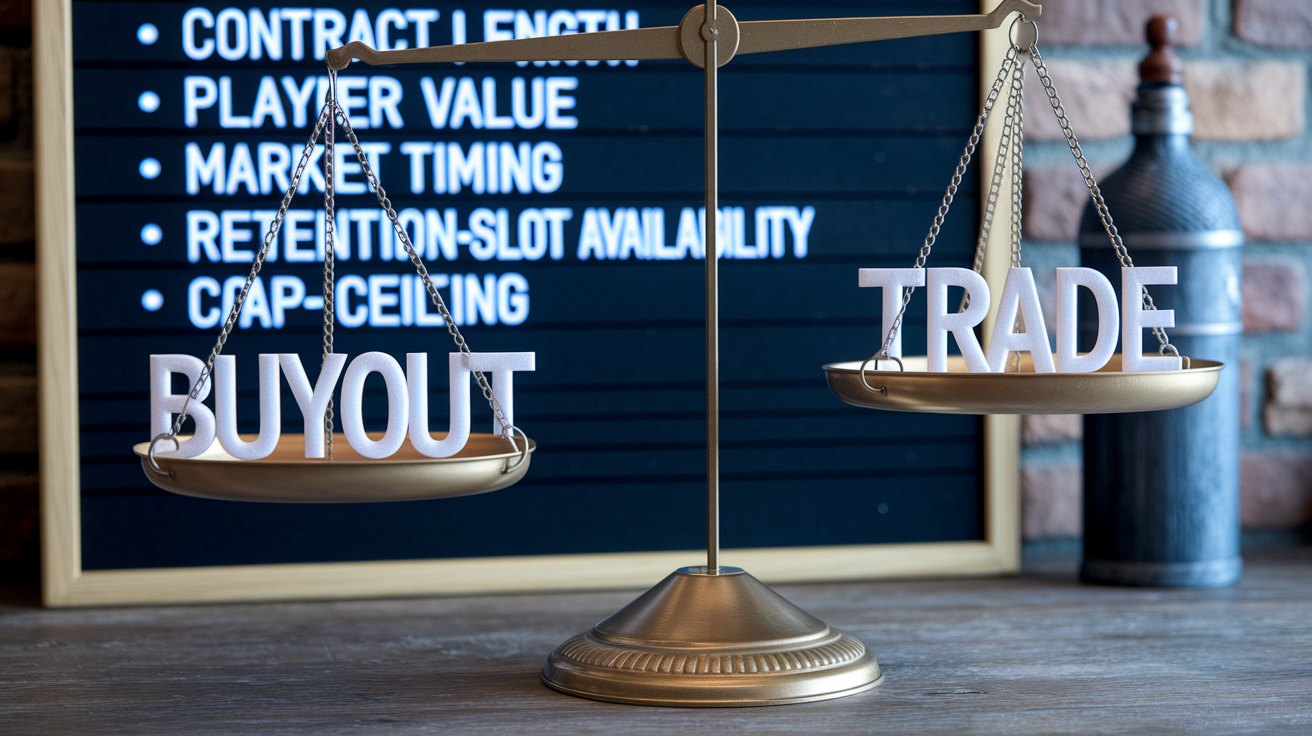
The decision hinges on contract length, player value, market conditions, organizational cap trajectory, and whether the priority is cap space now or flexibility later. A team with two years remaining on a deal and an upcoming free-agent class that requires cap room today might favor a buyout to open space immediately, accepting the four-year penalty as tolerable given the expected cap-ceiling rise. A franchise early in a multi-year rebuild with no immediate cap crunch should prioritize trades that return picks or prospects, even if those trades require salary retention. The asset return outweighs the short-term cap relief a buyout provides.
- Contract length: Deals with fewer than three years remaining produce shorter buyout tails (four to six years) and are harder to trade. Longer contracts are easier to move with retention but create extended buyout penalties if bought out.
- Player performance and age: A late-career player on a declining trajectory has minimal trade value and might be a stronger buyout candidate. A younger underperformer with term may attract interest from cap-floor teams willing to absorb salary for picks.
- Retention-slot availability: Teams already using two or three retention slots can’t facilitate additional trades and must consider buyouts or AHL burial. Clubs with open slots can retain aggressively to maximize trade returns.
- Market timing: Deadline and offseason conditions determine trade feasibility. If no market exists and the buyout window’s open, a buyout may be the only path to roster flexibility.
- Cap-ceiling outlook: If the league-wide cap’s rising and the team projects future space, carrying a buyout tail becomes less painful. If cap growth stalls, preserving flexibility via trades without retention is better.
A rebuilding club that values asset accumulation above everything else will default to trades whenever a market exists, even at the cost of retaining salary or accepting a lower pick return. A franchise facing immediate roster-crunch decisions or lacking retention-slot availability may choose the buyout path, absorbing the long-term penalty in exchange for clearing a spot and simplifying the cap structure today.
Final Words
Teams are choosing between buyouts and trades to reshape rosters. This post broke down how buyouts change cap math, how trades return picks and prospects, and why timing matters.
Buyouts free roster spots but leave long-term cap penalties. Trades can bring assets and speed a rebuild, but they hinge on market conditions and salary retention.
If you take one thing away, the impact of buyouts vs trades on nhl team rebuilding plans comes down to priorities — immediate flexibility versus asset recovery. Smart timing and clear goals make either choice work, so stay optimistic.
FAQ
Q: What is rule 48 in the NHL?
A: The NHL’s Rule 48 is the illegal-check-to-the-head rule that penalizes hits targeting a player’s head, letting refs and the Department of Player Safety assess in-game penalties and supplemental discipline.
Q: Is the number 69 banned in the NHL?
A: The number 69 is not banned in the NHL; the league has no official prohibition, though teams, equipment staff, or players sometimes avoid it because of its immature connotation.
Q: How do NHL buyouts affect salary cap?
A: NHL buyouts affect the salary cap by spreading the owed money over twice the remaining contract years, reducing current-year hits but creating smaller cap charges that can last for years.
Q: Is the NHL gaining or losing popularity?
A: The NHL’s popularity is mixed: viewership and attendance fluctuate by market, while international growth and streaming interest are rising, so overall change looks like gradual expansion, not a sharp swing.