
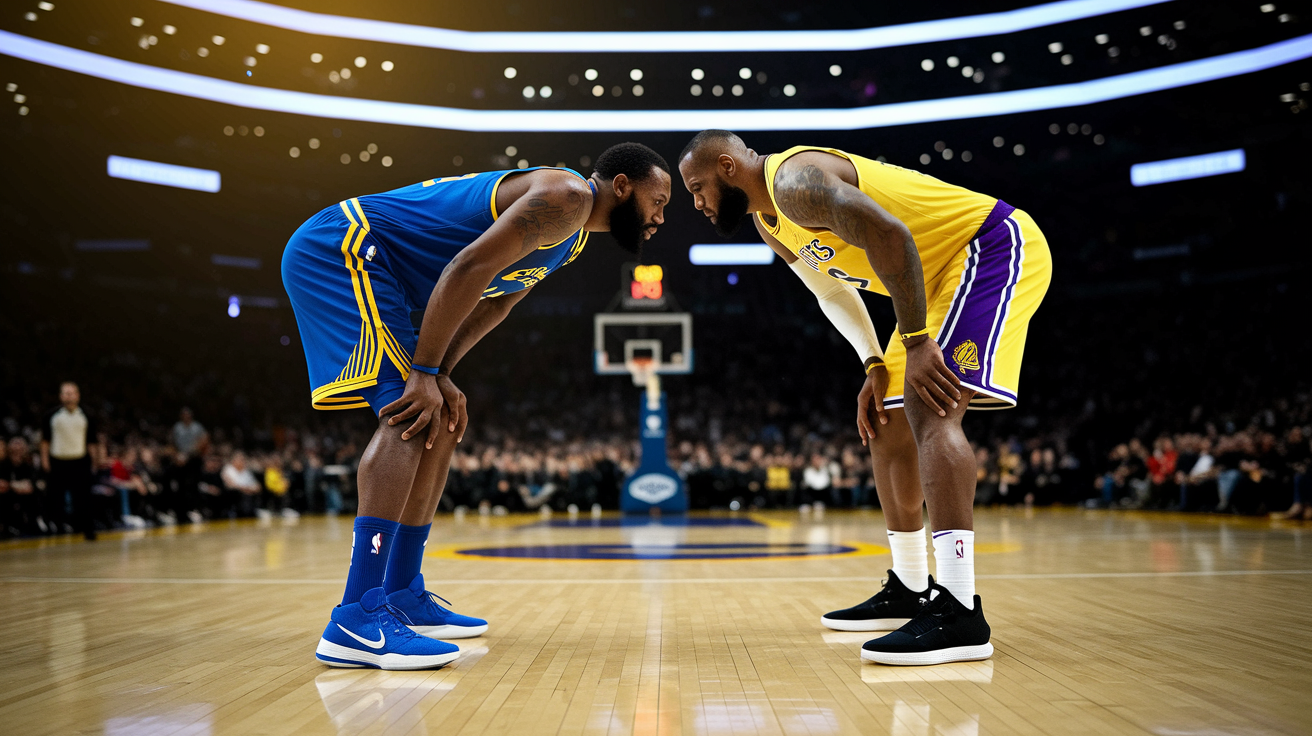

Was Game 4 of the 2016 Finals the moment LeBron’s legacy was saved and Draymond’s reputation reshaped?
A late-game swipe, a suspension, then an unlikely friendship, the arc sounds like a movie.
But these moments did more than make headlines.
They changed how teams prepared, how fans remember the 2016 title, and how two competitive stars balance tension and respect.
This timeline walks through the key confrontations between Draymond Green and LeBron James and explains why each incident mattered to rivalries, media narratives, and the modern NBA.
Definitive Timeline of Draymond Green vs LeBron James Incidents and Their Rivalry Impact
The Warriors and Cavaliers faced off in the NBA Finals four straight years, 2015 through 2018. Each series raised the stakes. And right in the middle of all that tension sat Draymond Green and LeBron James, two guys whose on-court battles eventually turned into something harder to categorize.
Game 4 of the 2016 Finals. 2:50 left on the clock. After a quick tangle, Green swiped at James below the belt. Both got technicals. Green called James a “bitch” during the exchange. The NBA reviewed it after the game and bumped Green’s contact to a Flagrant Foul 1. That made four flagrant points for Green in the 2016 postseason, triggering an automatic one-game suspension for Game 5. Without Green on the floor, the Cavaliers took over. LeBron and Kyrie Irving poured in 82 points combined at Oracle Arena, pushing the series to Game 6. The Warriors never won another game. Cleveland claimed its first and only NBA championship with three straight wins.
By 2017, things started shifting. Green showed up on LeBron’s show The Shop that year and again in 2018. Rich Paul later said the friendship just “happened naturally” around that time. Green switched to Klutch Sports in 2019. The two became business partners, investing together in Major League Pickleball in 2022. LeBron went to Green’s wedding in San Diego. When LeBron broke the all-time scoring record, Green tweeted seven goat emojis and “#38388,” even though he was stuck in Portland for a road game because his coach asked him to stay. On April 11, both attended a Hoop Summit to watch Bronny James.
Major incidents in order:
- 2015 Finals – Warriors beat Cavaliers for the title. Early tension set the stakes.
- June 2016, Game 4 – Green swipes LeBron with 2:50 left. Mutual technicals issued.
- Post-Game 4, 2016 – NBA upgrades it to Flagrant 1. Green gets his fourth flagrant point and an automatic suspension.
- Game 5, 2016 – Cavaliers win without Green. LeBron and Kyrie combine for 82. Series goes to Game 6.
- 2017–2018 – Green appears on The Shop twice. Off-court relationship starts forming.
- 2019 – Green joins Klutch Sports, formally linking up with LeBron’s business circle.
Analytical Breakdown of the 2016 Flashpoint and Its Broader Meaning
The suspension mattered not because of the foul but because of what it opened up. Cleveland had already dropped the first three games. Game 5 was their last chance, and Green’s absence gave them a window they attacked without hesitation. The Warriors’ entire system revolved around Green’s defensive flexibility and vocal leadership. Without him calling out switches and directing rotations, their defense lost its shape. LeBron and Kyrie went right at them, and the Cavaliers’ 112–97 win flipped the entire series.
Narrative-wise, the suspension rewrote the Finals from “Warriors dynasty locked in” to “LeBron delivers Cleveland’s first title.” Media coverage changed overnight. What had been a story about Golden State’s historic run became a referendum on Green’s emotional control and whether the Warriors had sabotaged their own legacy. Fans split hard along team lines. Cavaliers supporters saw the suspension as karma. Warriors fans called it an overreaction pushed by LeBron’s complaints to the league office. That divide still shapes how people remember the 2016 championship.
The psychological fallout stuck around. Green admitted years later that back then, “you want to take his head off” when facing LeBron. That intensity never fully went away, even after their off-court relationship warmed up. When asked about later playoff matchups, Green said the competitiveness “won’t be no different” and that guarding LeBron requires “a total team effort.” LeBron echoed the same thing, acknowledging their close friendship while noting it “doesn’t stop us from going out and competing at a high level.” The 2016 incident created a paradox: two players locked in public combat who privately respected and eventually worked with each other.
| Aspect | Effect on rivalry | Evidence |
|---|---|---|
| Media framing | Shifted Finals narrative from Warriors dominance to LeBron’s redemption arc | Coverage pivoted to Cleveland’s “comeback” story. Green’s absence became the defining subplot. |
| Psychological aftermath | Created lasting tension in later matchups despite off-court friendship | Green’s quote: “you want to take his head off.” Both players admit the competitiveness persists. |
| Legacy interpretation | Suspension labeled as one of the decade’s most pivotal playoff moments | Cavaliers’ only title directly tied to Green’s Game 5 absence. Warriors lost three straight. |
| Influence on future matchups | Heightened scrutiny on Green’s behavior and refereeing decisions in later series | Green’s 200+ career technicals. Ongoing debates about his role in Warriors’ Finals losses. |
Transition from Conflict to Friendship and How It Influenced Public Perception
Around 2017, the story started changing. Green began working with Maverick Carter on an Uninterrupted project and landed an endorsement with Beats by Dre, a brand LeBron had invested in. The two appeared together on The Shop, a setting that allowed candid, unscripted conversation. Rich Paul called the friendship organic, something that just developed once the competitive heat from those Finals years cooled a bit. By 2019, Green had switched his representation to Klutch Sports, formally tying himself to LeBron’s business world.
The public signals kept coming. LeBron attended Green’s wedding. They invested together in Major League Pickleball in 2022. When LeBron broke the all-time scoring record, Green posted seven goat emojis and “#38388” on social media, a gesture that felt real despite the rivalry’s history. Green and LeBron have said they “never discussed” the 2016 incident directly but plan to address it publicly “one day.” The relationship reframed the rivalry from pure antagonism into something more layered. A competition between professionals who understood each other’s drive and respected the grind.
Key public signals of reconciliation:
- Guest appearances on The Shop in 2017 and 2018, creating visible moments of collaboration
- Green’s switch to Klutch Sports representation in 2019, formalizing business ties
- Joint investment in Major League Pickleball in 2022, showing shared financial interests
- LeBron’s attendance at Green’s wedding in San Diego, marking personal-level friendship
- Green’s tweet saluting LeBron’s all-time scoring record with seven goat emojis and “#38388”
How Warriors–Lakers Matchups Revived Elements of the Green–LeBron Rivalry
When LeBron moved to the Lakers, the rivalry found a new stage. In 2021, the Lakers eliminated the Warriors in the play-in tournament, a result that stung Golden State. By April 28, 2023, both teams were moving through the playoffs. The Lakers beat Memphis. The Warriors beat Sacramento. That set up a second-round meeting. It was the first Warriors–Lakers playoff series since 1991, and the first time Green and LeBron faced each other in the postseason outside the Cavaliers era.
The competitive edge came back right away. Green said before the 2023 series that they wanted to “take his head off,” the same language he’d used to describe the earlier Finals battles. LeBron, now in Year 20, averaged 22 points, 12 rebounds, and 8 assists in two regular-season games against the Warriors that year. Green, in Year 11, and Curry, in Year 14, brought veteran savvy to a matchup that still carried weight. Green noted he expected to defend LeBron alongside Andrew Wiggins, calling it “a total team effort” that would shift over the course of a series.
Coaching and tactical adjustments in later Warriors–Lakers matchups:
- Green deployed alongside Wiggins to share LeBron defensive assignments and manage his stamina
- Warriors emphasized switching schemes to avoid isolations where LeBron could exploit mismatches
- Lakers countered by running LeBron in pick-and-roll actions targeting smaller Warriors defenders
- Both coaching staffs reduced early-game trash talk to prevent escalation. Green specifically withheld verbal jabs in Game 1 until opponents initiated.
Tactical and Psychological Elements Fueling Green vs LeBron Encounters
The psychological warfare between Green and LeBron runs deeper than most rivalries because both players know how to manipulate momentum. Green’s trash-talk philosophy centers on waiting for the opponent to make it “chippy” before he engages fully. He once recalled that LeBron never commented when Green wore LeBron’s sneakers during his “first 1, 2, 3 years” in the league. Green respected that restraint. “It’s just not something you do,” he said. But once things got heated on the court, “you just go wherever you gotta go.”
That approach showed up in specific games. Green held back his signature “you’re not me, you want to be me” line in Game 1 of certain matchups because his opponent wasn’t initiating trash talk. Once engagement started, Green escalated. The tactic works because it forces the other player to either absorb the verbal pressure or respond, creating a mental distraction. LeBron, who thrives on controlling tempo and emotion, recognized the challenge and generally avoided taking the bait, keeping the focus on execution rather than theatrics.
Defensively, Green’s strategy against LeBron involves disrupting rhythm before the ball arrives. He’ll deny early position, force LeBron into deeper catches, and communicate rotations loudly to make sure help arrives on drives. LeBron counters by using his size and court vision to create for others when Green overcommits. The tactical chess match feeds the psychological one. Each possession becomes a test of who can impose their will without breaking composure.
Psychological triggers that escalated incidents:
- Green’s verbal jabs timed to moments of frustration, like after missed shots or turnovers
- LeBron’s calm, methodical responses designed to neutralize Green’s energy and refocus his team
- Physical exchanges during loose balls or screen-setting, where contact could be interpreted as either competitive or excessive
Long-Term Legacy Effects of the Green–LeBron Rivalry
Green’s reputation as an emotional enforcer solidified because of this rivalry. His 200-plus career technical fouls show a pattern, but the 2016 suspension remains the single moment most often cited when evaluating his career. For some, it’s proof of a competitive edge that elevates teammates. For others, it’s evidence of poor decision-making that cost his team a championship. The duality defines how people view his Hall of Fame case. Undeniable defensive genius paired with undeniable volatility.
LeBron’s legacy absorbed the rivalry differently. The 2016 comeback became the centerpiece of his Cleveland story, and Green’s absence in Game 5 is inseparable from that narrative. LeBron’s ability to seize the opportunity reinforced his reputation as someone who capitalizes on opponents’ mistakes. The friendship that followed added another layer, positioning LeBron as someone who can compete fiercely and then build bridges afterward. Green’s public praise of LeBron in GOAT debates (like the seven goat emojis) also complicates simple narratives of animosity, showing that respect can coexist with rivalry.
| Player | Reputation shift | Evidence |
|---|---|---|
| Draymond Green | From rising defensive star to polarizing enforcer whose emotions carry championship-level consequences | 2016 suspension labeled as pivotal turning point. 200+ career technicals. Hall of Fame case debated around volatility vs. impact. |
| LeBron James | From Finals rival to business partner, reframing rivalry as complex competition-plus-friendship | 2016 comeback tied to Green’s absence. Friendship via Klutch/Uninterrupted. Green’s public GOAT acknowledgment (tweet with seven goat emojis). |
| Both players | Rivalry redefined modern NBA narratives by blending peak competitive intensity with visible off-court collaboration | Four straight Finals meetings (2015–2018). Joint investments (Major League Pickleball 2022). Public reconciliation signals despite ongoing competitive fire. |
Final Words
In the action, we walked a clear timeline, from Finals flashpoints in 2016 to the slow shift toward friendship and how later Warriors-Lakers matchups revived sparks. We broke down the 2016 suspension, tactical and psychological triggers, and the long-term reputation effects.
The draymond green vs lebron james incidents timeline and impact on rivalries shows how a few moments can swing games, shape stories, and later turn into business ties. It’s a rivalry that still matters—and it’s left both players stronger in different ways.
FAQ
Q: Do Draymond and LeBron get along?
A: Draymond and LeBron do get along. Their early feud cooled into a public friendship from 2017 to 2019, with joint media appearances, business ties, and mutual support.
Q: Did LeBron not go to Kobe’s funeral?
A: LeBron did attend Kobe’s public memorial at Staples Center; he joined other players, wore a Lakers jersey, and publicly paid tribute, so he did not skip the high-profile ceremony.
Q: What impact did LeBron James have on society?
A: LeBron James impacted society through activism, philanthropy, and media influence—founding the I PROMISE School, speaking on social issues, expanding athlete-owned media, and reshaping player power and business.
Q: What is Draymond Green’s impact on a team?
A: Draymond Green’s impact on a team is elite defense and playmaking; he anchors communication, sparks momentum, and provides physical leadership, though his intensity sometimes risks technicals and suspensions.