


Want David Pastrnak? Be ready to gut your roster, because that’s the short answer.
He’s 28, signed through 2031 at $11.25 million, and coming off his third straight 105-plus point season.
That mix makes him one of the costliest wingers in hockey.
This post breaks down the realistic price: a top-six NHLer, a blue-chip prospect, multiple first-round picks, and cap-clearing moves.
We’ll show why Boston can demand that haul and which real packages could actually land him.
Immediate Breakdown of the Acquisition Cost for David Pastrnak

David Pastrnak’s one of the NHL’s most valuable trade chips, and it’s not hard to see why. He’s 28, locked in through 2031 at $11.25 million per year, and he just rattled off three straight 105-plus-point seasons. You don’t find that combination sitting on the market. A franchise winger in his prime with six-plus years of control? That’s about as rare as it gets.
Boston’s surprise nosedive to last place in the Atlantic during 2025 sparked some trade talk, but don’t expect the Bruins to give him away. Superstar precedent says they’re going to demand a haul, and their organizational situation only backs that up. Their prospect pool’s thin, their draft picks are sparse, and they need to refill talent at every level. Even if they’re listening, the price stays sky-high.
Any real package has to hit multiple categories at once. Boston won’t take one star or a bunch of okay pieces. You need NHL talent that plays now, future upside that replaces what you’re losing, and enough draft capital to actually rebuild.
Here’s what it takes to get David Pastrnak:
- Top-six forward with term or cost control – Someone who can contribute right away, preferably under 28 and signed past this season.
- Blue-chip prospect or high-end young player – A guy with first-line or top-pairing potential who can replace future production.
- Multiple first-round picks – At least two to restock the pipeline and give Boston some trade flexibility.
- Additional futures (second-round picks or mid-tier prospects) – Secondary pieces that add depth and pump up the total return.
- Roster filler or cap-balancing player – A contract or player who makes the deal work under the cap, usually with minimal long-term value.
Contract Details of David Pastrnak and How They Shape His Trade Value

Pastrnak’s deal runs through 2030–31 at $11.25 million annually. That’s seven years of commitment. It’s a two-sided coin. You’re guaranteed his prime years with no free agency risk, but you’re also locking in a big chunk of your cap for most of the next decade. If your team’s tight against the ceiling or facing expensive extensions soon, you can’t even think about this without tearing apart your roster.
Three straight 105-plus-point seasons push the asking price way beyond what teams pay for aging stars or one-dimensional scorers. Pastrnak’s not a rental. He’s not a reclamation project. He’s a first-line anchor signed long-term. Boston can sit tight and wait for the right offer because most contenders can’t match the assets without gutting themselves.
| Contract Factor | Impact on Trade Value |
|---|---|
| $11.25M AAV | Forces acquiring team to clear cap space or include salary going back; raises baseline cost of entire package |
| Term through 2031 | Guarantees six-plus years of elite production; eliminates UFA risk and justifies premium asset cost |
| Three straight 105+ point seasons | Confirms consistent top-tier performance; positions Pastrnak as a franchise cornerstone rather than a declining asset |
Core Trade Assets Required to Acquire a Franchise Player Like Pastrnak

Any real offer starts with a cornerstone forward who can jump into Boston’s top six right now and a top prospect who can turn into a first-line or top-pairing player within two years. The Bruins aren’t trading Pastrnak for futures alone or a pile of depth pieces and conditional picks. They need someone who helps them compete today and a high-ceiling talent who can replace what they’re giving up. Without both, the conversation doesn’t go anywhere.
Cost-controlled young players add massive value because they let Boston restock without immediately taking on another huge cap hit. Shane Pinto fits that mold. He’s 24, coming off a career-high 37 points and 21 goals, and heading into restricted free agency. Drake Batherson’s another example: 27 years old, three straight 60-point seasons, 68 points in 2024–25, earning under five million. These guys give you proven NHL production at salaries that preserve flexibility.
Multiple first-round picks become essential when your prospect pool can’t supply the blue-chip talent Boston requires. If your farm system’s not deep, you’ve got to compensate with draft capital that gives the Bruins flexibility to restock over several years. The proposed Ottawa package included two first-round picks and one second-round pick alongside four players. That’s the reality of superstar trades. You need volume and quality across multiple categories.
- Core roster player – Established NHL contributor who can play top-six or top-four minutes and is signed beyond this season.
- Top prospect – High-ceiling player ranked in organizational top three, ideally with first-line or top-pairing projection.
- Additional young NHLer or depth piece – Cost-controlled player who adds immediate roster depth or future upside, like a bottom-six forward or third-pairing defenseman under 26.
- High draft capital – Multiple first-round picks or a first-round pick plus additional second or third-round selections to replace organizational pipeline losses.
Salary Cap Implications When Trading for David Pastrnak

Taking on an $11.25 million cap hit requires immediate and often painful roster moves. If you’re near the upper limit, you’ve got to clear space by trading out contracts or buying out players. You can’t just shuffle depth pieces to make room. Multiple meaningful salaries have to leave the roster or get restructured. Past scenario analysis showed teams exploring departures of players like Alex Iafallo, Sean Walker, and Matt Roy just to absorb a contract this size. Pursuing Pastrnak forces you to choose between keeping your current depth or adding a franchise winger.
The multi-season commitment reshapes roster planning for the next six-plus years. Cap space allocated to Pastrnak can’t be redirected to other stars or used to extend homegrown talent during that window. You’ve got to evaluate whether your competitive timeline aligns with his contract term and whether you can build around an $11.25 million anchor while managing other core players’ extensions, entry-level contract expirations, and free-agent additions. One trade decision locks in your financial structure for the better part of a decade.
| Cap Issue | Impact |
|---|---|
| Immediate space required | Acquiring team must clear or move $11+ million in cap hits before trade is processed |
| Long-term commitment | Six-plus years of cap allocation limits flexibility to sign other stars or extend core players |
| Roster construction constraints | Forces reliance on entry-level contracts and league-minimum depth to fill remaining roster spots |
Comparable Trades and Precedent for Acquiring an Elite Scoring Winger

The Jack Eichel trade serves as a structural benchmark for understanding what Boston would demand. That deal included four assets (two picks and prospects) and involved a star center signed long-term. Eichel’s return set a floor for superstar trades, proving teams must surrender multiple premium pieces regardless of contract status or injury history. Any Pastrnak package follows the same multi-asset framework. The Bruins expect at least one blue-chip prospect, one roster player, and multiple high draft picks.
Pastrnak’s superior production raises the cost beyond many precedents. He’s delivered three consecutive 105-plus-point seasons and remains healthy and consistent, unlike Eichel, who was traded amid injury concerns and organizational friction. Pastrnak’s a more reliable asset with no injury red flags and a proven track record of playoff performance. Boston can justify asking for more than what Buffalo received. The absence of any internal drama or declining performance only strengthens their leverage.
Recent superstar trades consistently include these components:
- Top prospect with first-line or top-pairing upside – A player ranked in the trading team’s top three organizational prospects.
- Established roster player under team control – An NHL contributor signed beyond the current season, often cost-controlled.
- First-round draft pick – At least one unprotected first-round selection, often two.
- Additional pick or secondary prospect – A second-round pick or mid-tier prospect used to increase total return and provide organizational depth.
Impact of No-Movement and Trade-Protection Clauses on a Potential Pastrnak Deal

Earlier contract language included a no-movement clause paired with a modified no-trade clause requiring submission of a 10-team no-trade list. Pastrnak controlled which destinations he’d accept. If those protections remain in place, the number of realistic suitors shrinks immediately. Only teams on his approved list can negotiate, and Boston can’t force a trade to the highest bidder if that team’s blocked. Trade-protection clauses shift leverage away from the trading team and toward the player, which can lower the return if fewer teams compete.
Requiring Pastrnak’s approval adds leverage for the Bruins in one specific way. If he signals willingness to waive for only a handful of contenders, those teams know they face limited competition and may be more willing to meet Boston’s asking price. But if Pastrnak refuses to waive for most bidders, Boston’s options narrow and the Bruins may need to accept a return below their ideal valuation. The interplay between contract protections and player preference often determines whether a trade happens at all. In Pastrnak’s case, his willingness to move would be the first domino.
Performance Metrics That Drive Pastrnak’s Trade Value
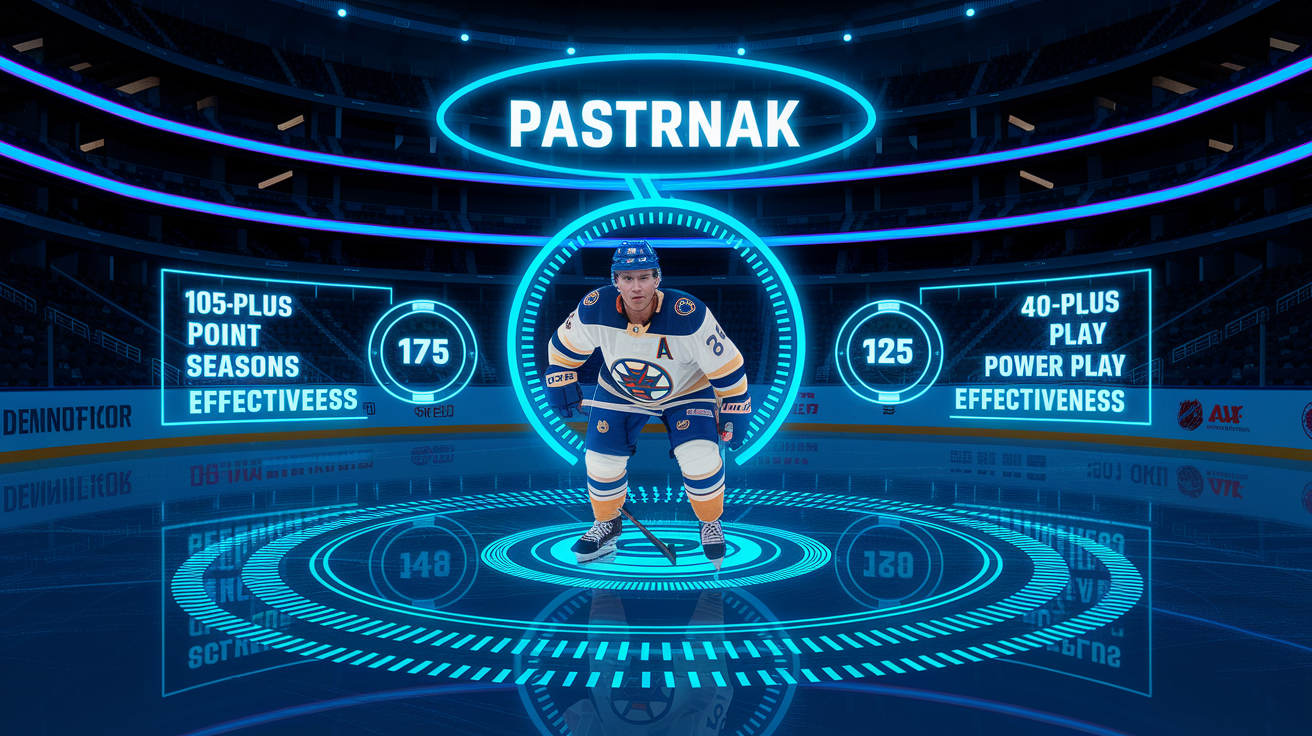
Pastrnak’s posted three consecutive 105-plus-point seasons, placing him among the NHL’s most productive wingers over that span. His goal-scoring ability consistently reaches 40-plus goals per year, with projections suggesting he can hit 50 in the right offensive system. That combination of volume scoring and multi-category production makes him one of the few wingers capable of driving an entire offensive attack, not just complementing other stars.
Power-play effectiveness adds another dimension to his value. Pastrnak operates as a primary shooting option on the man advantage and converts at elite rates. He contributes production in the situations that often decide playoff games. His ability to score on the power play, at even strength, and in transition makes him a matchup problem for opposing coaches. Teams pursuing him know they’re acquiring a player who impacts the game in every offensive zone scenario.
Consistency and playoff scoring further justify his cost. Pastrnak’s delivered in high-leverage postseason situations and doesn’t disappear when the stakes rise. His track record includes deep playoff runs and multi-point performances against top defensive units, confirming he’s built for the moments that matter most. That reliability in critical games separates franchise players from talented regular-season scorers and explains why Boston would demand a package that reflects championship-caliber value.
Realistic Trade Scenarios and Feasibility Analysis for Acquiring Pastrnak

Trade frameworks vary significantly depending on whether the acquiring team can guarantee a contract extension. In the “extension guaranteed” model, the acquiring team negotiates a long-term deal before completing the trade, lowering Boston’s risk and slightly reducing the asset cost. One past scenario proposed a seven-year extension at $9.5 million annually, paired with a package including a top prospect, a first-round pick, and a second-round pick. That framework assumes the acquiring team absorbs both the current contract and the extension risk, allowing Boston to focus on asset quality rather than quantity.
The “no extension” model flips the equation. Without a long-term commitment, Boston must assume the acquiring team might lose Pastrnak to free agency or face a contentious negotiation, so the Bruins demand a higher return to compensate for uncertainty. One no-extension scenario included two roster-ready prospects instead of draft picks, reflecting Boston’s need to replace immediate production if Pastrnak’s future remains unclear. Only playoff contenders can realistically pursue him under either model. Teams in rebuild mode can’t justify surrendering assets for a player whose prime years would be wasted outside the postseason.
Three example frameworks based on real analysis:
-
Ottawa scenario – Senators receive David Pastrnak. Bruins receive Shane Pinto, Drake Batherson, Nikolas Matinpalo, Stephen Halliday, two first-round picks, and one second-round pick. This package combines a young center (Pinto), a proven top-six winger (Batherson), a cost-controlled depth piece (Matinpalo), a top AHL scorer (Halliday), and significant draft capital.
-
LA extension scenario – Kings receive David Pastrnak with a seven-year, $9.5 million extension. Bruins receive Brandt Clarke, 2022 first-round pick, and 2023 second-round pick. This model prioritizes a blue-chip defensive prospect and high draft capital, assuming the extension lowers overall asset cost.
-
LA no-extension scenario – Kings receive David Pastrnak without extension assurance. Bruins receive Brock Faber and Gabriel Vilardi. This framework emphasizes NHL-ready players who can contribute immediately, compensating Boston for the risk of losing Pastrnak after one season.
Final Words
Want Pastrnak? Short version: he’s elite, 28, locked at $11.25M through 2031, so teams need top picks, blue‑chip prospects and roster talent.
We covered realistic packages, cap math, no‑trade limits and Eichel-style precedent. Bottom line: even if Boston’s motivated, it takes multiple premium assets and roster moves to fit the cap.
So if you were wondering what would it take to acquire David Pastrnak, the answer’s simple: a blockbuster haul — rare, but doable for the right contender.
FAQ
Q: How did William Nylander and David Pastrnak become friends?
A: The friendship between William Nylander and David Pastrnak began through Sweden’s hockey system and national‑team camps, where shared junior programs, international tournaments, and NHL events kept Swedish players close.
Q: How much does David Pastrnak make a year?
A: David Pastrnak makes $11.25 million per year under his current contract, which is the cap hit/average annual value and runs through the 2030‑31 season.
Q: Is David Pastrnak a good player?
A: David Pastrnak is an elite NHL scorer, posting three straight 105+ point seasons and regular 50‑goal upside, which firmly places him among the league’s top right wingers.
Q: Did David Pastrnak lose a child?
A: There are no confirmed public reports that David Pastrnak lost a child; credible outlets have not verified such a claim, so any online mentions should be treated as unconfirmed.