
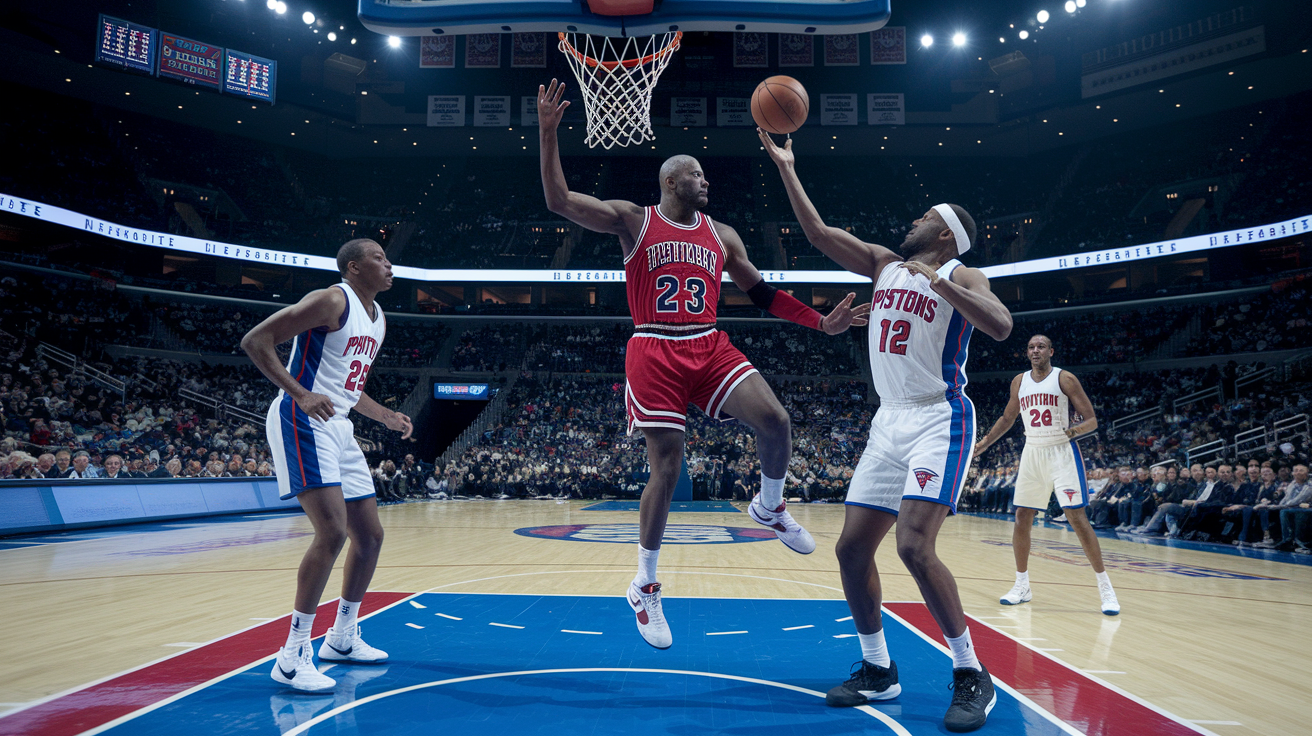

Could a bruising, rule-bending defense actually teach Michael Jordan to win?
The Bulls vs Pistons 1988-1991 rivalry was exactly that: Detroit’s Bad Boys used the Jordan Rules and physical play to beat Chicago three straight years, then the Bulls fought back, added muscle, the triangle offense, and Scottie Pippen grew into a true second option.
This analysis breaks down the tactics, turning points, and top moments, from the Jordan Rules to Detroit’s walk-off in 1991, that finally handed the crown to Chicago.
Overview of the Bulls–Pistons Rivalry (1988–1991)
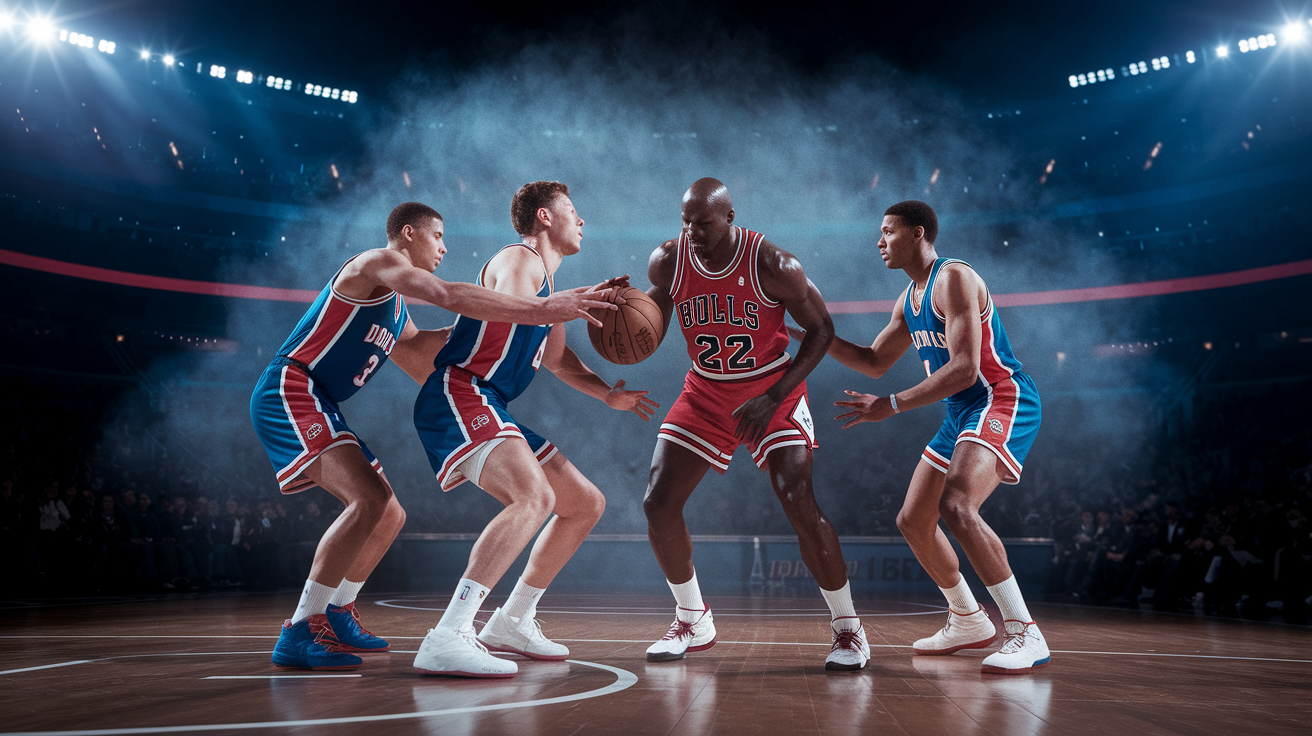
The Bulls and Pistons rivalry from 1988 to 1991 was one of the most physically brutal stretches in NBA history. Detroit’s “Bad Boys” built their championship reputation on aggressive defense, psychological intimidation, and a scheme created specifically to neutralize Michael Jordan (the “Jordan Rules”). Chicago entered as a rising power led by Jordan’s scoring brilliance, but the Bulls didn’t have the physical toughness or tactical depth to overcome Detroit’s layered defense and mental warfare.
Detroit knocked Chicago out of the playoffs three straight years (1988, 1989, and 1990), each series exposing different cracks in Chicago’s roster and mental makeup. The Pistons forced Jordan to become a passer by sending waves of defenders at him the second he crossed half court, daring Chicago’s supporting cast to beat them. The strategy worked until Phil Jackson installed the triangle offense and Jordan added muscle to absorb contact, while Scottie Pippen developed into an elite second option who could relieve offensive pressure.
The rivalry reshaped Eastern Conference competition and set the tactical blueprint for defending superstar scorers throughout the late 1980s and early 1990s. Detroit’s physical style forced the league to eventually re-evaluate defensive contact rules. Chicago’s 1991 sweep of the Pistons marked the generational transition from the Bad Boys’ reign to the Bulls’ dynasty. The emotional intensity peaked in the final meeting when Detroit walked off the court before the final buzzer, refusing to shake hands after being swept.
What made this rivalry historically intense:
- Physical defense that pushed the boundaries of legal contact, with hard fouls and body checks used to wear down Chicago’s stars
- Detroit’s defensive innovation with the Jordan Rules, forcing the ball out of Jordan’s hands through coordinated double and triple teams
- Psychological warfare and trash talk that turned each playoff series into a mental battle as much as a physical contest
- Contrasting team identities. Detroit’s blue-collar grit versus Chicago’s emerging superstar-driven model
- High stakes with championship implications, as both teams repeatedly met at the peak of their powers with NBA Finals berths on the line
Season‑by‑Season Breakdown of the Rivalry (1988–1991)
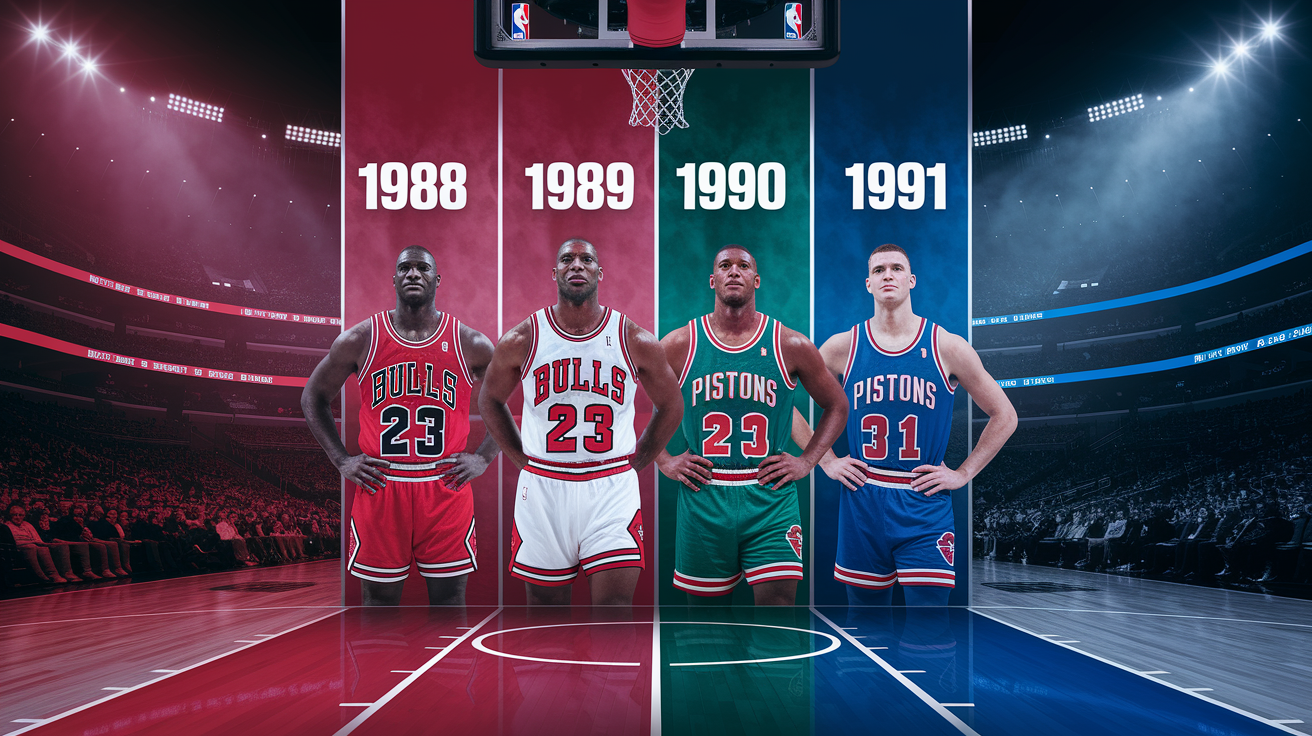
1988 Playoff Matchup
Detroit established dominance in the 1988 Eastern Conference Semifinals, eliminating Chicago 4‑1 on May 18, 1988. The Pistons’ physical approach overwhelmed a Bulls team still learning how to compete at championship level. In the decisive Game 5, Detroit won 102‑95 behind a balanced attack led by Isiah Thomas (25 points, 9 assists), Adrian Dantley (22 points), and Bill Laimbeer, who scored 13 of his 19 points in the fourth quarter to close out the series.
Michael Jordan managed just 4 points in that final quarter as Detroit deployed repeated double teams that forced him into passing situations. The Pistons exposed Chicago’s mental fragility. The Bulls complained about fouls and showed visible frustration rather than maintaining composure. Rookie Horace Grant provided a bright spot with 20 points on 9‑of‑11 shooting early in the game, but Chicago had no sustainable answer when Detroit tightened its defense in crunch time. After dispatching the Bulls, Detroit went on to beat the Celtics in the Eastern Conference Finals before losing to the Lakers in seven games in the NBA Finals.
1989 Playoff Matchup
The 1989 Eastern Conference Finals saw Detroit win 4‑2 despite Jordan averaging over 32 points per game throughout the series. Chicago had improved defensively and showed better mental toughness, but the Pistons’ depth and experience proved decisive in close games. Detroit refined its defensive rotations, using Joe Dumars, Dennis Rodman, and a rotating cast of defenders to wear down Jordan over the course of each game while daring Chicago’s secondary scorers to beat them.
The series featured multiple physical confrontations as Detroit continued to test Chicago’s willingness to absorb punishment. Jordan responded with explosive scoring nights, but the Bulls still lacked the offensive diversity needed to counter Detroit’s scheme. The Pistons advanced to win their first NBA championship by sweeping the Lakers in the Finals, validating their physical style and cementing the Jordan Rules as an effective blueprint for containing the league’s most dangerous scorer.
1990 Playoff Matchup
The 1990 Eastern Conference Finals represented Chicago’s closest challenge to Detroit’s reign, a seven‑game battle that saw the Pistons escape with a 4‑3 series victory. The Bulls had added firepower and toughness, but Scottie Pippen’s migraine in a crucial game undermined Chicago’s chances. Detroit’s experience in tight games and willingness to engage in physical warfare at every possession proved just enough to outlast the Bulls.
Both teams traded victories throughout the series, with several games decided by single possessions in the final minutes. Jordan showed he could perform under the heaviest defensive pressure Detroit could apply, but the Bulls still needed another layer of tactical sophistication and mental resilience. The Pistons went on to repeat as NBA champions, but this series signaled that Chicago’s window was opening and Detroit’s might be closing. The gap had narrowed to a razor’s edge.
1991 Playoff Matchup
Chicago broke through with a dominant 4‑0 sweep in the 1991 Eastern Conference Finals, dismantling the aging Pistons with improved physicality, superior depth, and tactical refinement under Phil Jackson’s triangle offense. Jordan had added 15 pounds of muscle to better handle Detroit’s contact, while Pippen emerged as a legitimate second star capable of creating offense when the Pistons committed extra defenders to Jordan. The Bulls no longer complained about physical play. They matched it and often initiated it.
Detroit’s defensive scheme collapsed because Chicago now had multiple playmakers who could exploit the attention Jordan commanded. The triangle offense created better spacing and forced the Pistons to defend the entire floor rather than just collapsing on Jordan. In the final game, Detroit’s players walked off the court with time remaining, refusing to congratulate the Bulls in a moment that symbolized the bitter intensity of the rivalry and the definitive passing of the torch. Chicago went on to capture the first of six championships in the 1990s, while Detroit’s Bad Boys era ended in frustrated silence.
Strategic Dynamics and Tactical Evolution
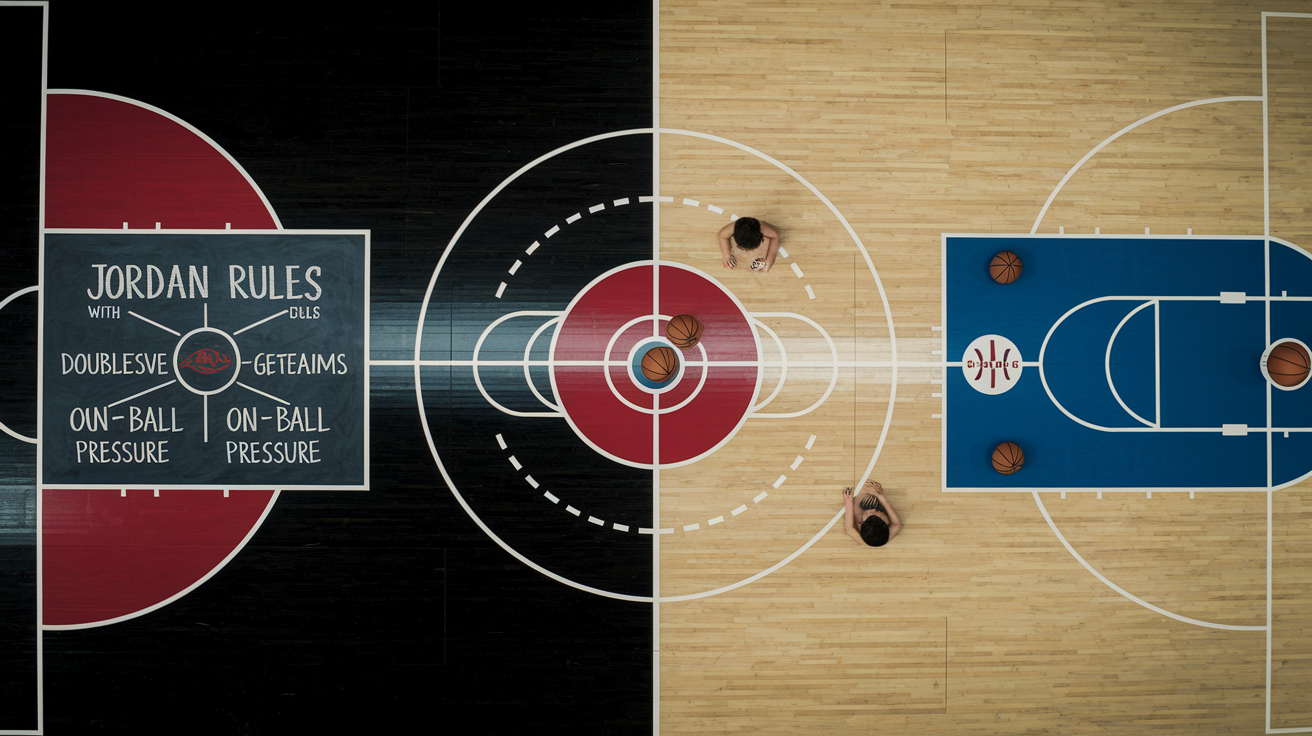
Detroit’s defensive innovation centered on the Jordan Rules, a coordinated scheme that funneled Jordan toward help defenders and forced him to give up the ball rather than attempt his usual scoring drives. The Pistons rotated fresh defenders onto Jordan throughout games, using a combination of Dumars’ on‑ball pressure, Rodman’s athleticism, and Laimbeer’s physical presence in the paint to wear him down physically and mentally. Detroit’s strategy accepted that Jordan would get his points but aimed to make every basket exhausting and to deny him easy rhythm.
Chicago’s tactical response evolved across the three years of defeats. Phil Jackson’s installation of the triangle offense in 1989 provided the structural answer Detroit’s scheme required. The system emphasized ball movement, multiple decision‑makers, and spacing that punished aggressive traps. As Pippen developed into an All‑Star, the Bulls gained a second playmaker who could attack when Jordan drew double teams, fundamentally breaking the logic of the Jordan Rules. Chicago also embraced physicality, adding muscle and adopting a more aggressive defensive identity that matched Detroit’s intensity rather than wilting under it.
Strategic shifts that contributed to Chicago’s eventual success:
- Triangle offense implementation created multiple offensive threats and better spacing, making Detroit’s traps less effective
- Jordan’s physical transformation (adding 15 pounds of muscle) allowed him to absorb contact and finish through Detroit’s defensive pressure
- Pippen’s development into an elite playmaker gave Chicago a second star capable of exploiting the attention Jordan commanded
- Mental toughness upgrade across the roster, with Chicago learning to match Detroit’s physicality and psychological warfare rather than complain about it
Key Players and Their Impact
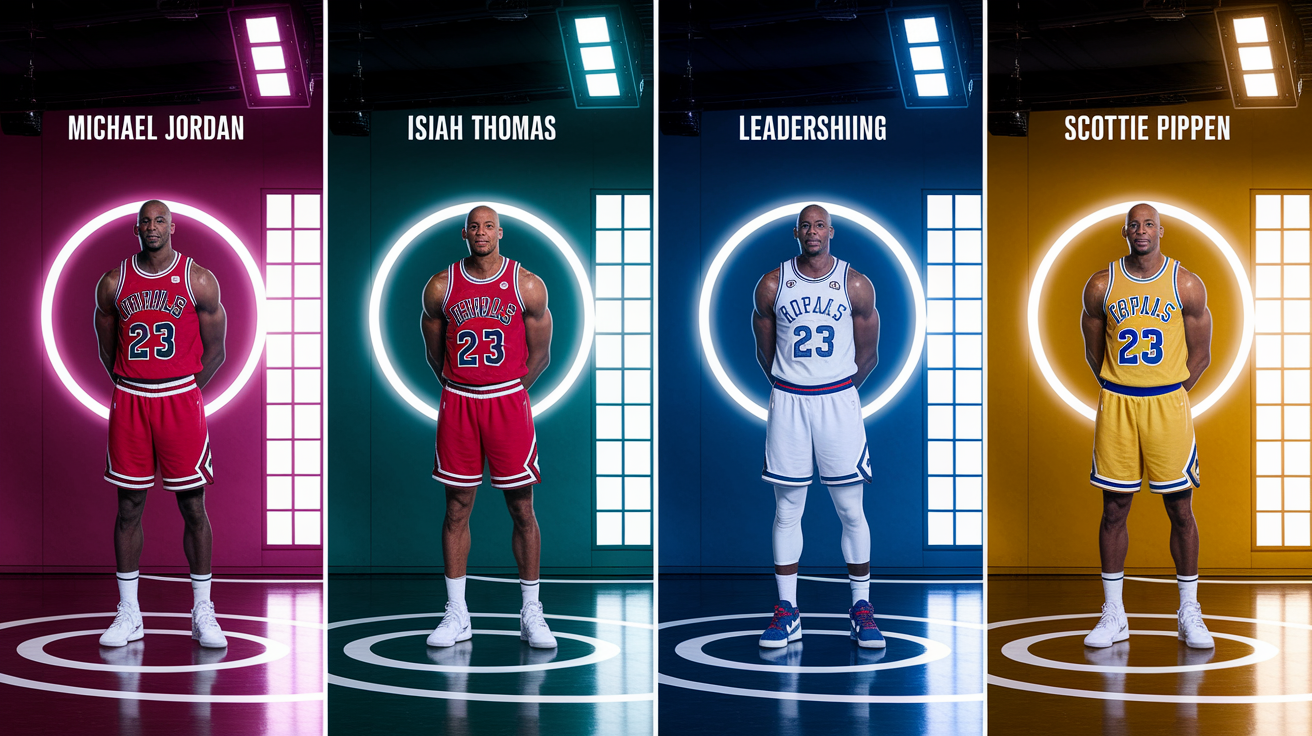
Michael Jordan averaged over 30 points per game across most of the playoff series while carrying Chicago’s offense under relentless defensive pressure. His scoring explosions kept the Bulls competitive even when the supporting cast struggled, but Jordan’s real evolution came in his willingness to trust teammates and operate within the triangle system. By 1991, Jordan had transformed from a pure scorer into a complete player who could dominate games through playmaking and defense when Detroit’s scheme took away his scoring lanes.
Isiah Thomas led Detroit with a combination of clutch shot‑making, elite playmaking, and psychological leadership that defined the Bad Boys’ identity. Thomas orchestrated the Pistons’ offensive attack while also serving as the emotional heartbeat of a team built on toughness and mental warfare. His ability to score in critical moments and his willingness to absorb punishment while delivering it made him the perfect leader for Detroit’s physical style.
Dennis Rodman emerged as one of the league’s premier defenders during the rivalry, using his athleticism, relentless energy, and basketball IQ to disrupt Chicago’s offense. Rodman’s ability to guard multiple positions and crash the boards gave Detroit defensive versatility that few teams could match. His psychological games and willingness to do the dirty work perfectly complemented Detroit’s approach.
Scottie Pippen’s growth from promising young player to legitimate All‑Star changed the entire dynamic of the matchup by 1991. Pippen’s ability to handle the ball, defend multiple positions, and score efficiently when Jordan drew defensive attention gave Chicago the second star necessary to crack Detroit’s scheme. His emergence turned Chicago from a one‑man show into a multidimensional championship contender.
| Player | Key Impact | Notable Stat |
|---|---|---|
| Michael Jordan | Offensive engine and scoring brilliance under extreme defensive pressure | 32+ PPG in 1989 series despite Jordan Rules |
| Isiah Thomas | Orchestrated Detroit’s offense and provided clutch scoring | 25 points, 9 assists in 1988 closeout game |
| Dennis Rodman | Elite defender and rebounder who anchored Detroit’s physical scheme | Multiple All-Defensive selections during rivalry years |
| Scottie Pippen | Developed into second star who broke Detroit’s defensive strategy | Emerged as All-Star by 1990, key to 1991 sweep |
Most Iconic Moments of the Rivalry
The rivalry produced several moments that defined an era and shaped how both franchises are remembered. The 1991 walk‑off stands as the most controversial, when Detroit’s players left the court with time remaining rather than congratulate the Bulls after being swept. A breach of sportsmanship that symbolized the bitter emotions the rivalry had generated. The moment captured both Detroit’s pride and the painful reality that their championship window had closed.
Six moments that defined the Bulls–Pistons rivalry:
- Bill Laimbeer’s 13‑point fourth‑quarter performance in the 1988 closeout game, including a late three‑pointer that sealed Chicago’s elimination and announced Detroit’s arrival as a championship contender
- Jordan’s fourth‑quarter shutdown in Game 5 of the 1988 series, when Detroit held him to just 4 points by deploying waves of defenders and forcing him into uncomfortable passing situations
- The migraine game in 1990 when Scottie Pippen struggled with severe headaches during a crucial contest, undermining Chicago’s best chance to break through before 1991
- Multiple hard fouls and physical confrontations throughout all four series, with Detroit’s defenders delivering punishment on drives and Chicago learning to match that intensity
- Jordan’s 1991 series performance after adding muscle, showing he could now absorb Detroit’s contact and finish through it rather than being worn down
- The final buzzer of the 1991 sweep, when the generational transition became official and the Bulls claimed the Eastern Conference throne Detroit had held for three years
Statistical Summary of the Rivalry
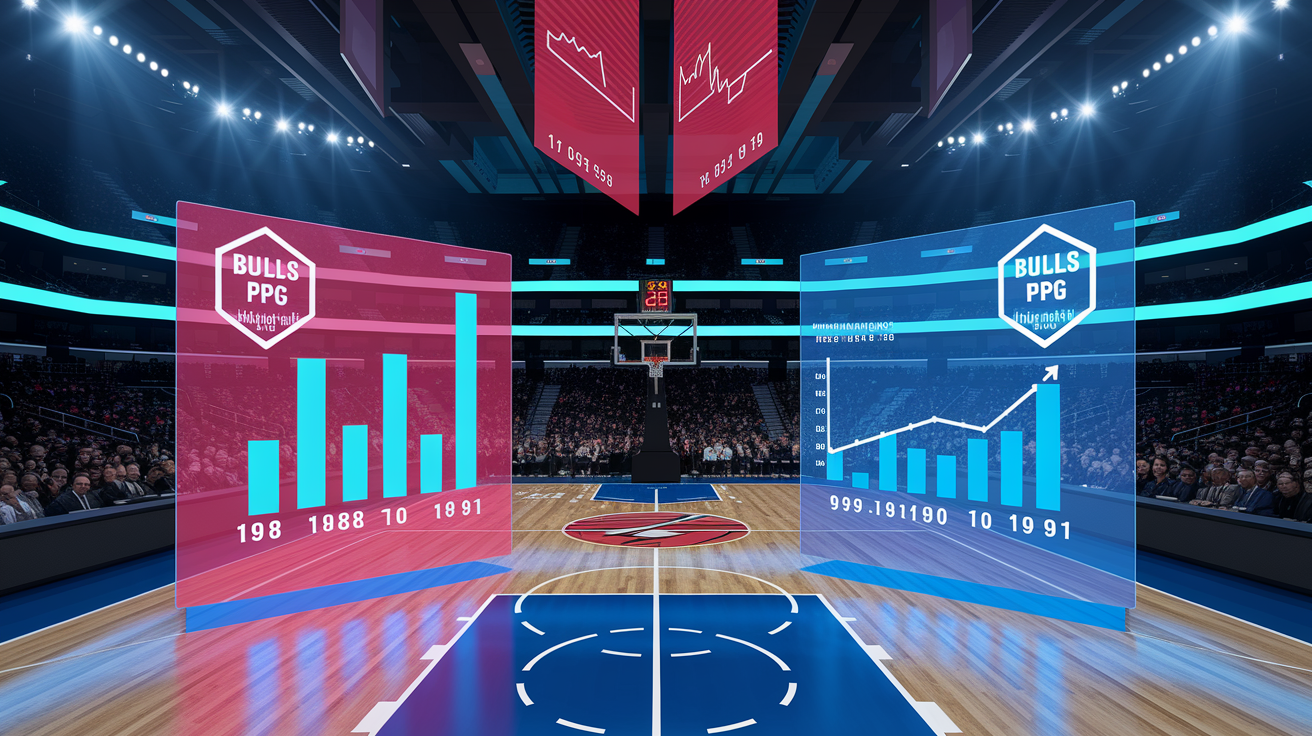
The numbers tell the story of a rivalry that tightened progressively until Chicago broke through. Detroit controlled the early matchups through superior depth and defensive execution, but Chicago’s offensive and defensive ratings improved each year as the roster matured and the triangle offense took hold. The Pistons’ ability to win close games in 1989 and 1990 reflected championship experience, while Chicago’s sweep in 1991 showed how completely the Bulls had closed the gap and surpassed their rivals.
| Year | Series Result | Bulls Avg PPG | Pistons Avg PPG | Notable Stat |
|---|---|---|---|---|
| 1988 | Pistons 4‑1 | 96.8 | 102.4 | Jordan held to 4 points in Game 5 fourth quarter |
| 1989 | Pistons 4‑2 | 99.3 | 103.7 | Jordan averaged 32+ PPG in losing effort |
| 1990 | Pistons 4‑3 | 101.6 | 104.1 | Seven‑game series with multiple single‑possession finishes |
| 1991 | Bulls 4‑0 | 107.5 | 93.5 | Chicago’s defensive rating held Detroit 14 points below season average |
Long‑Term Legacy of the Bulls–Pistons Rivalry

The rivalry launched the Bulls’ dynasty by forcing organizational and individual evolution that shaped the 1990s NBA landscape. Chicago’s six championships in the decade stemmed directly from lessons learned in defeats to Detroit. The need for physical toughness, tactical diversity beyond Jordan’s scoring, and mental resilience under playoff pressure. The Bad Boys taught Chicago what championship basketball required, and the Bulls used that education to build a dynasty that surpassed Detroit’s two‑title run.
Detroit’s legacy remains defined by the physical, defensive identity the Bad Boys established and the tactical innovation of the Jordan Rules. The Pistons proved a team built on defense, depth, and collective toughness could win championships in a star‑driven league, influencing defensive schemes for decades. The rivalry also contributed to later NBA rule changes regarding defensive contact, as the league gradually moved away from the physical style Detroit perfected. The 1991 walk‑off became a cautionary tale about sportsmanship, but it also reflected the genuine intensity and high stakes that made the rivalry compelling. These teams genuinely disliked each other, and the basketball mattered enough to generate real emotion rather than manufactured drama.
Final Words
The Bad Boys’ physical defense met Jordan’s relentless scoring across four brutal seasons. Detroit won the first three playoff meetings before Chicago finally swept in 1991 — a clear turning point.
We walked through each year, the tactical chess moves, and the players who changed the game. You saw how the Jordan Rules, the triangle offense, and pure grit shaped the outcome.
This bulls vs pistons 1988-1991 rivalry analysis and top moments captures why the matchup mattered then and still echoes across the NBA today. It’s a reminder that fierce rivalries can launch dynasties.
FAQ
Q: Why are Bulls and Pistons rivals?
A: The Bulls and Pistons are rivals because Detroit’s “Bad Boys” used physical defense and the Jordan Rules to repeatedly stop Chicago in late‑80s playoffs, creating bitter, high‑stakes clashes that shaped the era.
Q: What did Michael Jordan say about Jerry Krause’s death?
A: Michael Jordan said he was saddened by Jerry Krause’s death and acknowledged Krause’s role in assembling the Bulls’ championship teams, offering respect for Krause’s contributions despite past tensions.
Q: What was significant about the 88 Finals?
A: The 1988 Finals mattered because Detroit reached the championship, proving the Bad Boys were legitimate contenders and setting the stage for their late‑80s title runs and continued rivalry with Chicago.
Q: What was special about the 1991 Bulls?
A: The 1991 Bulls were special because they broke through with their first NBA title, swept the Pistons in the East Finals, and launched the core dynasty led by Michael Jordan and Phil Jackson’s system.